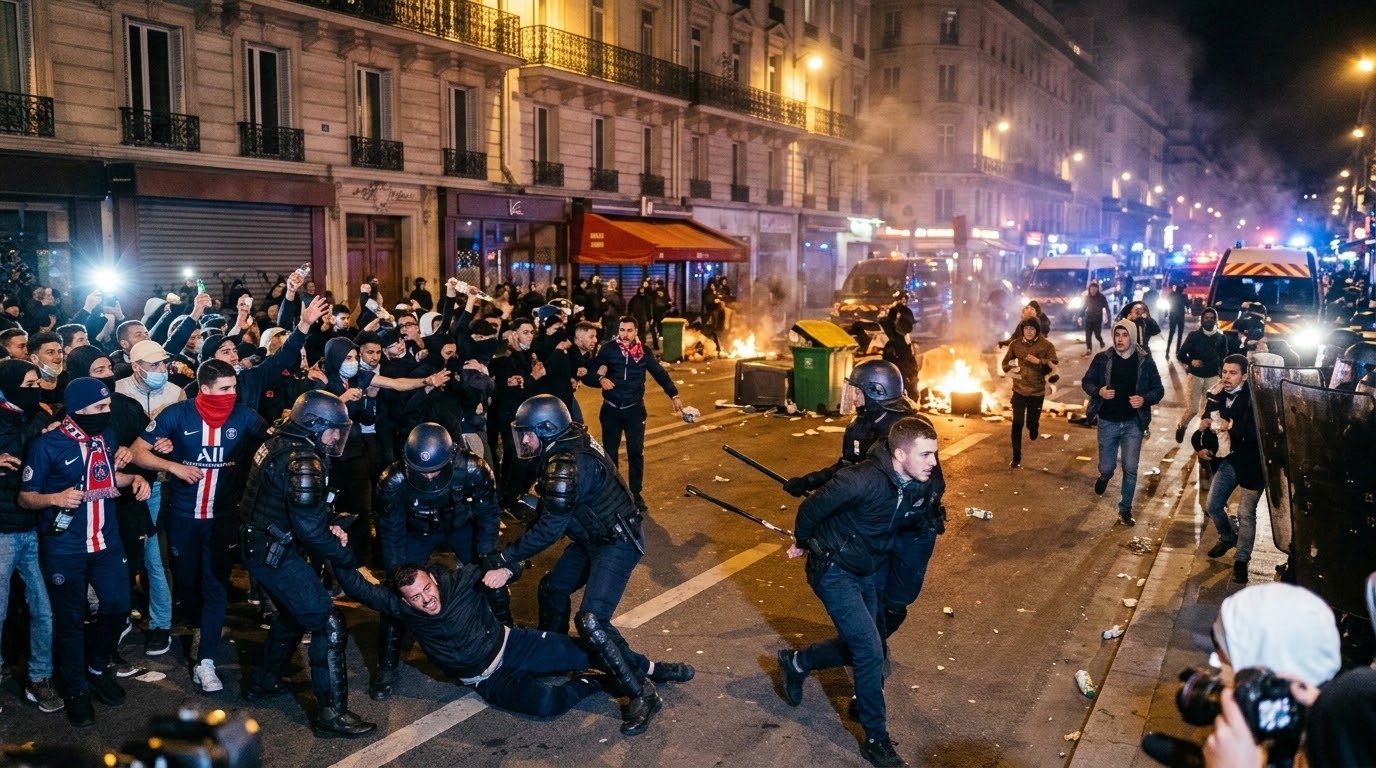
French police arrested 127 people across the Paris metropolitan area overnight after disorder broke out during celebrations of Paris Saint-Germain’s Champions League semifinal victory, Interior Minister Laurent Nunez said on Thursday, underscoring security risks ahead of the club’s May 30 final against Arsenal in Budapest.
What Happened
Speaking to Europe 1 radio, Nunez said 107 of the arrests were made within Paris city limits after PSG, the reigning European champion, knocked out Bayern Munich to reach a second consecutive Champions League final and its third since 2020. Authorities reported clashes near Parc des Princes and along the Champs-Elysees, where police dispersed groups and stopped attempts to block the Paris ring road.
Nunez said 11 people among those involved in the unrest were injured, including one person seriously hurt in an incident involving a mortar. He added that 23 police officers suffered minor injuries. The interior minister condemned what he described as repeated violent behavior by small groups during major celebrations, saying they sought confrontation with law enforcement rather than participating peacefully.
He also praised police operations, saying officers acted under instructions to protect public order, prevent property damage and stop looting. In his remarks, Nunez signaled concern about preparations for the final, saying security planning needed to be coordinated carefully after Paris officials publicly discussed creating a fan zone in the capital.
Impact & Consequences
The violence has sharpened pressure on French authorities to balance celebration and security during major sporting events, particularly in Paris where spontaneous gatherings can quickly swell. For residents and businesses in central districts, recurring clashes raise concerns over safety, damaged storefronts and transport disruption whenever high-profile matches end.
Politically, Nunez’s comments highlighted friction between national security officials and city leadership over event planning. His apparent criticism of recently elected Paris Mayor Emmanuel Gregoire for announcing a final fan zone before prior police consultation points to coordination challenges that could affect crowd management decisions in coming weeks. The incident also has implications for France’s public-order strategy more broadly, as authorities weigh increased deployments, movement controls and rapid-intervention tactics to avoid a repeat of overnight unrest during the final.
Background & Context
Post-match disorder linked to major football moments is not new in Paris or elsewhere in France. When PSG won the Champions League last year, police made more than 500 arrests nationwide. During those celebrations, a man in his 20s died in Paris after his scooter was struck by a car, and disturbances continued into the next day.
Previous incidents show a longstanding pattern. After PSG lost the 2020 Champions League final to Bayern Munich, Paris police arrested 148 people amid street clashes and vandalism affecting vehicles and shops. In 2013, when PSG secured the French title after a 19-year wait, celebrations were disrupted by prolonged confrontations with riot police that left 30 injured. Similar unrest has also followed major international football results, including Algeria’s 2019 Africa Cup of Nations victory, a Morocco-Algeria Arab Cup match in 2021, and the day France and Morocco both reached the 2022 World Cup semifinals.
International Response
No formal international condemnation had been issued by major multilateral bodies by Thursday, but the events are likely to draw close attention from football and security authorities across Europe as PSG prepares to face Arsenal in Hungary. Host-country planners in Budapest are expected to review the Paris disturbances as part of risk assessments for traveling supporters.
Clubs, local officials and police agencies in multiple countries have increasingly shared intelligence and operational practices around high-risk fixtures, particularly after episodes of fan violence tied to major continental competitions. With a Champions League final involving large cross-border travel and concentrated fan gatherings, European stakeholders will be watching how French and Hungarian authorities coordinate prevention, crowd flows and emergency response.
What to Expect Next
French officials have already indicated that security measures will be strengthened for the May 30 final, with decisions pending on the location and management of any Paris fan zone. In the coming days, authorities are expected to finalize deployment numbers, transport controls and protection plans for commercial areas. The key question will be whether tighter coordination between city and national officials can allow public celebrations while avoiding renewed violence.