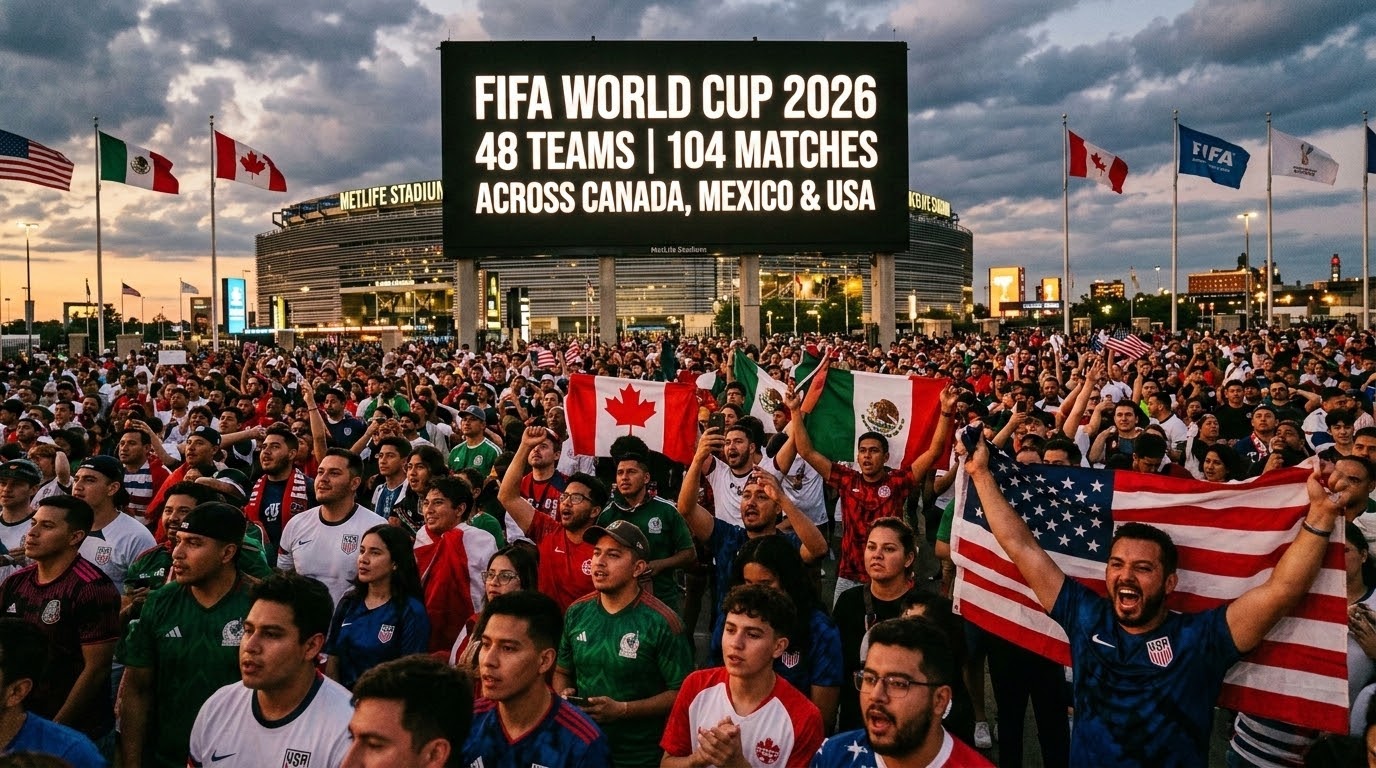
FIFA has confirmed the full framework for the 2026 men’s World Cup, with a record 48 national teams and 104 matches scheduled over 39 days in Canada, Mexico and the United States, marking the tournament’s return to North America for the first time since 1994 and signaling a major expansion of the sport’s flagship event.
What Happened
The governing body outlined group allocations, opening fixtures and knockout scheduling for the 23rd World Cup edition. The competition starts on June 11 in Mexico City at 3 p.m. local time, where Mexico face South Africa. It will conclude on July 19 at 3 p.m. local time with the final at MetLife Stadium in New Jersey, officially renamed “New York New Jersey Stadium” for tournament use.
Sixteen venues across the three host nations will stage games. FIFA said all host stadiums will use city-based tournament names to limit ambush marketing by non-partner brands. That means, for example, SoFi Stadium will operate as “Los Angeles Stadium,” while MetLife will carry the New York-New Jersey designation. Early marquee fixtures include the United States against Paraguay in Los Angeles, Brazil against Morocco in New Jersey, and Argentina’s opener against Algeria in Kansas City.
The group phase features 12 pools, labeled A through L, each with four teams. Defending champions Argentina enter Group J alongside Algeria, Austria and Jordan. The hosts are split across separate groups: Mexico in Group A, Canada in Group B, and the United States in Group D. Four teams are set for their first World Cup finals appearances: Cape Verde, Curacao, Jordan and Uzbekistan. After the first round, the competition moves through a round of 32, round of 16, quarterfinals, semifinals, a third-place playoff, and the final.
Impact & Consequences
The expanded format changes the competitive and commercial scale of the World Cup. With 104 total matches, broadcasters, sponsors, transport systems and host cities face a longer, denser event window than in previous editions. More teams also mean wider global representation, offering additional nations access to football’s largest stage and potentially accelerating investment in emerging football markets.
For North America, the tournament carries substantial economic and logistical implications. Cities in all three countries will manage cross-border fan movement, security coordination and event operations over more than five weeks. Match dispersal across Mexico, Canada and the US also creates a shared hosting model that could influence future mega-events. On the football side, traditional powers such as Argentina, Brazil, France, England and Germany remain central title contenders, but a larger field increases the probability of surprise runs in the knockout bracket.
Background & Context
The 2026 competition follows Argentina’s triumph at Qatar 2022 under captain Lionel Messi, a campaign that restored the South American side to the top after a 36-year gap. The upcoming edition is also the first men’s World Cup to include 48 teams, up from 32, representing FIFA’s long-term strategy to expand participation and global reach.
North America last hosted the men’s World Cup in 1994, when the United States staged the tournament alone. This time, the tri-nation model reflects deeper regional cooperation in sports administration and infrastructure planning. FIFA’s stadium renaming policy is also consistent with its commercial controls at prior tournaments, where venue branding is standardized for official rights holders. Structurally, the introduction of a round of 32 creates an additional knockout phase compared with earlier formats, extending both the sporting calendar and operational demands.
International Response
Host-country football authorities have framed the tournament as a landmark moment for the region. Organizers in Mexico, Canada and the United States have highlighted the symbolic opening in Mexico City and the final in New Jersey as evidence of a distributed but unified event. FIFA, for its part, has emphasized scale, access and global inclusion in presenting the expanded format and debut nations.
Across the football community, attention has focused on the group composition and travel demands. Analysts have pointed to tight scheduling across multiple time zones and long-haul movements between venues as major variables that could affect player recovery and tactical preparation. Supporters from emerging teams, particularly first-time qualifiers, have welcomed the broader pathway to participation, while established football nations are preparing for a potentially longer route to the title than in previous cycles.
What to Expect Next
The immediate focus will shift to final qualification outcomes, detailed matchday logistics and team camp planning as June approaches. FIFA and local organizing bodies are expected to release further operational guidance on transport, fan access and security across host cities. On the pitch, the opening week will set the tone quickly, with host nations and defending champions under early scrutiny before the expanded knockout rounds begin.