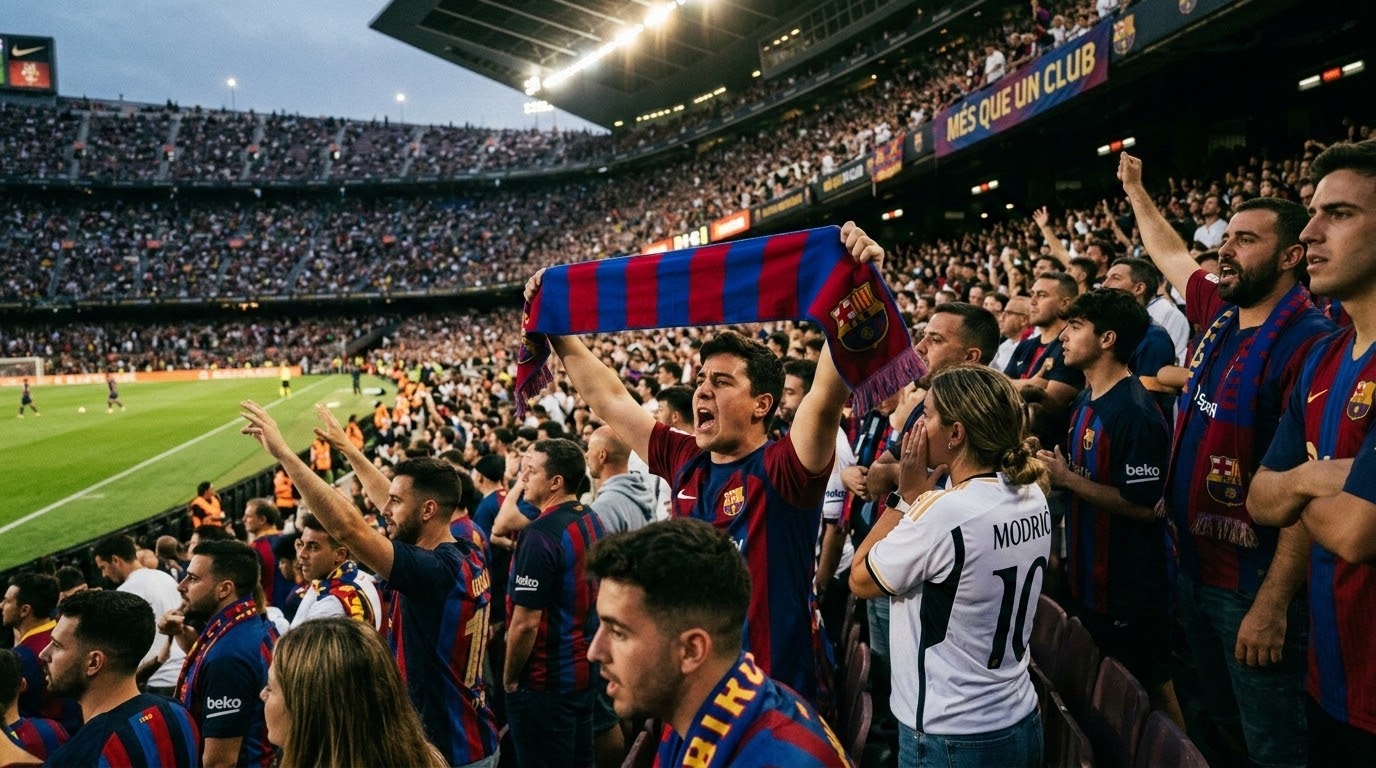
Barcelona and Real Madrid will meet on Sunday in the 264th edition of El Clasico, with the La Liga title potentially decided in Catalonia. Hansi Flick’s champions can seal another league crown on home soil, while Alvaro Arbeloa’s struggling Real must win to delay celebrations and preserve any mathematical chance.
What Happened
The match arrives at a volatile moment for both clubs, but especially for Madrid. Real are 11 points behind Barcelona with four league fixtures left, leaving almost no margin for error. Any result other than a Madrid victory would confirm Barcelona as champions in front of their own supporters. Despite both Spanish giants exiting the UEFA Champions League at the quarterfinal stage, Barcelona have remained steady domestically and are now positioned to retain the league title with room to spare.
Team news has intensified the pressure around the visitors. Kylian Mbappe, 27, is doubtful due to a hamstring problem ahead of the game. The France forward leads this season’s La Liga scoring chart with 24 goals. Mallorca striker Vedat Muriqi is second with 21, while Barcelona’s Lamine Yamal, ruled out for the rest of the campaign, has 16. Mbappe’s on-field output has not insulated him from fan anger: a campaign calling for the club to move him on has reportedly gathered more than 33 million signatures.
Madrid’s preparations were further disrupted by a training-ground clash on Thursday involving Federico Valverde and Aurelien Tchouameni. Valverde was taken to hospital with a head injury and has been ruled out for Sunday. The club said it has opened an internal investigation and will begin disciplinary procedures involving both players. It remains uncertain whether Tchouameni will be available for the Clasico while the process continues.
Impact & Consequences
The immediate sporting consequence is clear: Barcelona are one result away from confirming another league championship, while Real risk ending a second straight season without a major trophy. For Barcelona, clinching the title against their historic rivals would carry symbolic weight beyond the standings, reinforcing domestic control after European disappointment. For Madrid, failing to win would sharpen scrutiny of the team’s direction, recruitment choices and dressing-room management during a campaign marked by instability.
There are also wider institutional implications. Uncertainty around Mbappe’s fitness, combined with supporter unrest and internal disciplinary action following the Valverde-Tchouameni incident, has created a difficult public narrative for the club. In a fixture watched globally, the result and performance could influence perceptions ahead of the final weeks of the season, shaping debate over coaching, player accountability and squad planning for the next transfer window.
Background & Context
El Clasico is among the most enduring rivalries in world sport, and Sunday’s meeting extends a history spanning 124 years. The first encounter between the sides took place on May 13, 1902, in the Copa de la Coronacion, a forerunner of the Copa del Rey. Barcelona won that game 3-1 in Madrid against the club then known as Madrid FC, before it later became Real Madrid. Across 261 official meetings to date, Real have 106 wins and Barcelona 105, underscoring how tightly matched the fixture has remained.
The term “El Clasico” entered Spanish newspaper use in the 1960s, though the matchup had already developed into a defining domestic contest. Its global profile surged in the 1990s and early 2000s, through eras associated with Johan Cruyff’s Barcelona, Real’s star-driven Galacticos period, and later the Guardiola-Mourinho bench rivalry alongside Lionel Messi and Cristiano Ronaldo on the pitch. In league honors, Real lead historically with 36 titles, while Barcelona are now targeting number 28.
International Response
International attention around this fixture has been intense, with global sports broadcasters and football media framing Sunday as both a title decider and a stress test for Madrid’s internal cohesion. Analysts outside Spain have focused on two threads: whether Mbappe can return in time to influence the result, and whether the disciplinary cloud over Valverde and Tchouameni reflects deeper problems inside the squad during a high-pressure run-in.
Supporter communities worldwide have also amplified the pre-match debate, particularly around the anti-Mbappe petition, which has become a major talking point despite his scoring record. Coverage across Europe and beyond has highlighted the contrast between Barcelona’s domestic consistency and Madrid’s turbulence, presenting this Clasico as a match with implications not only for the title race but also for each club’s strategic narrative heading into next season.
What to Expect Next
Attention now turns to final team selections and medical decisions before kickoff in Barcelona. Confirmation on Mbappe’s condition and Tchouameni’s status is expected close to match time, while Valverde is already unavailable. If Barcelona avoid defeat, they will be crowned champions immediately; if Real win, the title race stays alive briefly. Either way, Sunday’s result is likely to shape the closing weeks of La Liga and the summer agenda at both clubs.