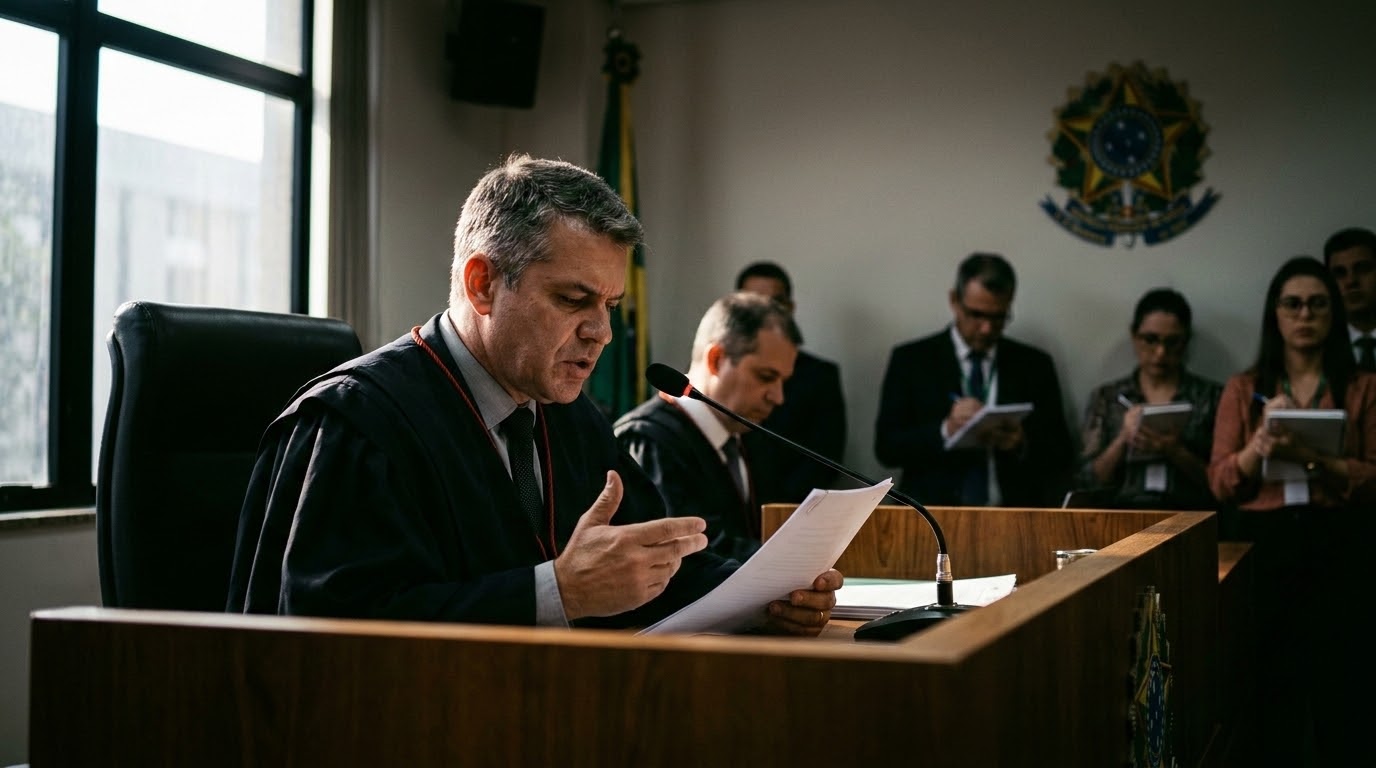
Brazil’s Supreme Court has temporarily blocked a new law that could significantly reduce former President Jair Bolsonaro’s prison term, escalating a constitutional clash between the judiciary and Congress over accountability for the 2022 post-election coup plot. Justice Alexandre de Moraes issued the suspension on Saturday, pending a full court review.
What Happened
Justice de Moraes ordered the immediate suspension of the recently enacted sentence-reduction measure until Brazil’s Supreme Federal Court can hold a plenary hearing on appeals that question whether the law violates the constitution. The ruling effectively pauses legal attempts by convicted defendants to seek shorter prison terms under the new statute.
The law was passed in December by a conservative-majority Congress and was widely viewed as potentially benefiting Bolsonaro and others convicted in the same case. Bolsonaro, 71, was sentenced by the Supreme Court in September to 27 years in prison for participating in a scheme aimed at overturning the 2022 election result after his defeat by President Luiz Inacio Lula da Silva. His legal team filed a fresh appeal on Friday, asking justices to reverse what they described as a grave miscarriage of justice.
President Lula had vetoed the legislation in January, but lawmakers aligned with Bolsonaro overrode that veto in late April, turning the bill into law. Afterward, plaintiffs petitioned the court to strike the measure down as unconstitutional. De Moraes’ order now freezes the practical application of the law, including individual petitions from defense lawyers seeking sentence recalculations for those convicted in the coup-related proceedings.
Impact & Consequences
The suspension keeps Bolsonaro’s 27-year sentence intact for now and preserves legal uncertainty for other defendants convicted in the same conspiracy case. By halting sentence-reduction requests before they can be processed, the court has prevented immediate changes to prison terms that Congress appeared ready to enable. For Bolsonaro’s allies, the decision is likely to deepen claims that the judiciary is overreaching. For opponents, it reinforces the principle that major criminal judgments involving alleged attacks on democratic order should not be rapidly diluted by subsequent legislation.
Institutionally, the move sharpens tensions among Brazil’s branches of government. Congress asserted legislative power by overriding Lula’s veto, while the Supreme Court has now stepped in to review whether that power was used within constitutional limits. The resulting standoff carries broader implications for Brazil’s legal system: it tests how far lawmakers can go in altering penalties tied to crimes against democratic institutions, and whether the court will set durable limits on retroactive relief in politically charged convictions.
Background & Context
Bolsonaro’s conviction stems from allegations that he helped orchestrate efforts to remain in office after losing the 2022 election to Lula. The case became one of the most polarizing legal battles in contemporary Brazil, with supporters portraying the prosecution as politically motivated and critics arguing it was an essential test of democratic accountability. When the Supreme Court delivered a 27-year sentence in September, it marked one of the harshest outcomes ever imposed on a former Brazilian president in a case linked to constitutional order.
The later congressional push for sentence reductions transformed the case from a criminal matter into a direct constitutional dispute. Lula’s veto signaled executive resistance to easing punishments for those found guilty in the plot, but the congressional override demonstrated the strength of Bolsonaro-aligned lawmakers. Since then, constitutional challenges have focused on whether the law improperly interferes with final judicial decisions. De Moraes’ suspension reflects the court’s effort to prevent irreversible legal effects while it evaluates those claims in full.
International Response
There was no immediate formal response from major foreign governments at the time of the ruling, but the case is being closely watched abroad as a barometer of democratic resilience in Latin America’s largest country. Diplomats, legal analysts, and regional observers have tracked Brazil’s handling of post-election destabilization efforts as part of a wider global conversation on how democracies confront leaders accused of undermining electoral outcomes.
International legal and policy circles have generally focused on two competing concerns visible in Brazil’s dispute: safeguarding due process for politically prominent defendants, and ensuring that institutions can enforce accountability for anti-democratic conduct. The Supreme Court’s intervention, by freezing the law rather than deciding the merits immediately, is likely to be read externally as an attempt to manage institutional conflict through judicial procedure while preserving short-term legal stability.
What to Expect Next
The immediate next step is a full Supreme Court hearing on the constitutionality of the sentence-reduction law. Until that decision, Bolsonaro and other convicted defendants cannot obtain relief through the suspended mechanism, even as appeals continue. The eventual ruling could either reopen a path to reduced terms or permanently block it, shaping not only Bolsonaro’s legal future but also the boundary between congressional legislation and final court judgments in Brazil.