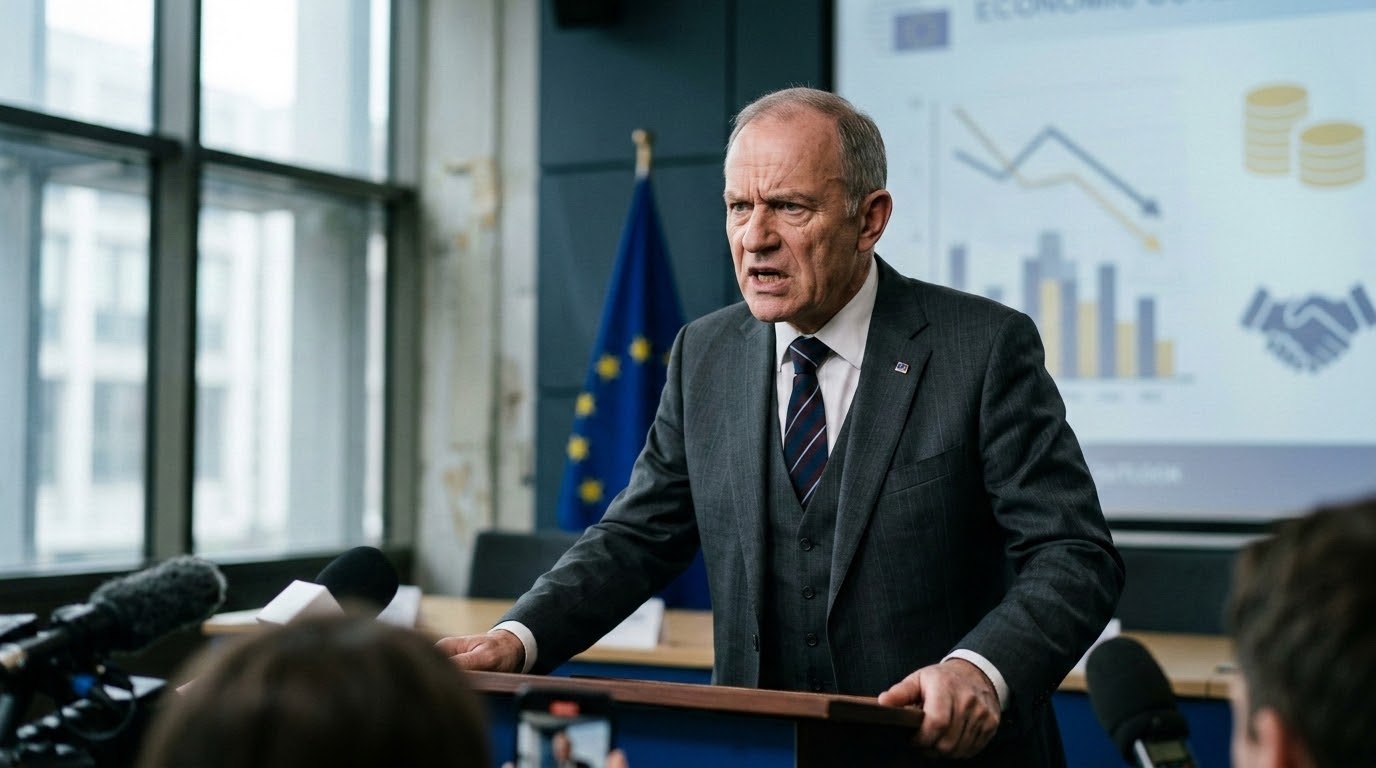
Germany’s finance minister, Lars Klingbeil, said in Berlin that President Donald Trump’s military campaign in Iran has directly worsened Germany’s economic outlook, after officials cut projected tax revenues for 2026 to 2030 by about €70 billion. The warning underscores how Middle East hostilities are reverberating through Europe’s largest economy.
What Happened
Speaking as the government updated its medium-term fiscal projections, Klingbeil said the downgrade reflected the economic fallout from what he described as Trump’s “irresponsible” war in Iran. German officials now expect significantly lower tax intake over the next five years than previously forecast, with the estimated gap put at around €70 billion, equivalent to roughly $82 billion or £60.52 billion.
The finance minister argued that the conflict has triggered a global energy shock, pushing up fuel and related costs at a moment when Germany is already struggling with weak growth. Berlin has spent months trying to restart momentum in an economy burdened by expensive energy, sluggish export demand, and years of near-stagnation. The new forecast reduction adds pressure on public finances and could complicate spending plans across federal ministries.
The economic warning comes amid a worsening political rift between Berlin and Washington. Last month, Chancellor Friedrich Merz said the US had been “humiliated” by Iranian negotiators, comments that angered Trump. The US president responded publicly, accusing Merz of misunderstanding the nuclear issue and attacking Germany’s broader economic and domestic policy performance. Days later, the Pentagon announced plans to withdraw 5,000 US troops from Germany, a move widely linked to an order by Defense Secretary Pete Hegseth.
Impact & Consequences
The immediate consequence for Germany is fiscal tightening risk. Lower tax receipts can limit room for stimulus, social spending, and industrial support at a time when the country is trying to revive growth and maintain competitiveness. If high energy prices persist, pressure on manufacturing, transport, and energy-intensive sectors could deepen, further weakening revenue and investment.
The broader impact extends beyond Germany. Roughly one-fifth of global oil and liquefied natural gas trade normally passes through the Strait of Hormuz, and disruptions linked to the war have sent fuel prices higher internationally. The conflict has also raised concerns about a wider global slowdown, as elevated energy costs feed inflation and squeeze household and business spending. At the diplomatic level, the dispute has added strain to the US-European relationship, with economic security now tied more directly to military decisions in the Gulf.
Background & Context
The latest dispute builds on a year of increasingly tense exchanges between Trump and Merz. Since taking office, Merz has repeatedly suggested that Washington’s policy direction has altered the traditional trans-Atlantic partnership. In February, he said a deep divide had opened between Europe and the United States, though he still visited the White House twice over the year to manage tensions.
Germany and several other European governments have criticized the US-Israeli war launched against Iran on 28 February, warning that prolonged conflict would damage the global economy. Merz had questioned Washington’s strategy, saying he could not see a clear exit path. After his remarks about failed negotiations and US embarrassment, Trump escalated his criticism online and later signaled military repositioning in Europe. Germany’s defense minister said the troop reduction decision had been foreseeable, but it still carried symbolic weight given that the US deployment in Germany remains Washington’s largest in Europe.
International Response
European capitals have watched the US-Iran confrontation with growing concern, largely focusing on energy security, shipping routes, and the risk of economic contagion. Trump has pressed allies to support efforts to reopen the Strait of Hormuz, which Iran has effectively closed, but support has not been uniform. NATO politics have also colored the dispute, as Trump has long criticized alliance burden-sharing and linked security commitments to policy alignment.
On the conflict itself, both sides are currently observing a ceasefire intended to open the way to a settlement. Trump said on Wednesday that the war would end quickly, while Iran has said it is considering a US proposal. Yet talks remain stalled: the US has maintained a blockade on Iranian ports and is simultaneously seeking safe passage for nearly 2,000 ships stranded in the Gulf since February, leaving maritime and diplomatic tensions unresolved.
What to Expect Next
Attention now turns to whether ceasefire diplomacy can produce a durable deal and stabilize Gulf shipping. For Germany, upcoming budget decisions will show how Berlin manages a major revenue shortfall while trying to protect growth. Investors and policymakers will watch fuel prices, freight flows through Hormuz, and the implementation of the planned US troop drawdown from Germany as indicators of whether economic and strategic strains begin to ease or intensify.