Nearly a month after the first onboard death, the cruise ship MV Hondius reached Tenerife on Sunday as Spanish authorities began a high-security medical evacuation of more than 100 people, seeking to contain a rare Andes-strain hantavirus outbreak that has already killed three passengers and triggered a multinational emergency response.
What Happened
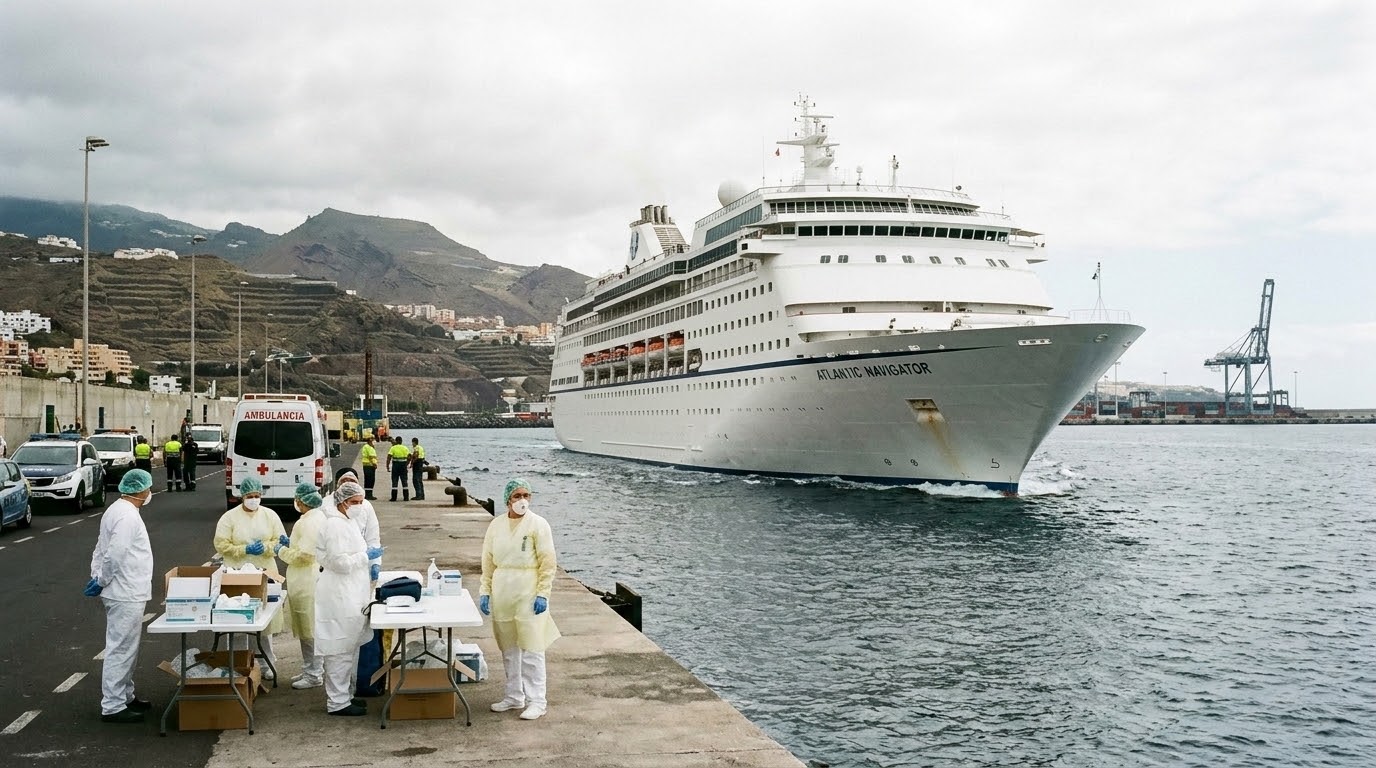
The vessel arrived near the port of Granadilla before dawn, but did not immediately dock under normal conditions. Officials imposed a one-nautical-mile security perimeter as it approached, while military police and civil protection teams secured the industrial port area. Large reception tents were erected and access to the waterfront was tightly restricted ahead of the transfer process.
By around 07:00 local time, medical teams were expected to board and assess passengers and crew for signs of infection. Authorities said no additional symptomatic cases had been identified in the latest checks. The disembarkation plan called for people to be separated by nationality and moved ashore in small boats, then transferred to charter aircraft waiting at Tenerife’s airport for repatriation flights coordinated by multiple governments.
Spanish Interior Ministry officials said the United Kingdom, the United States and several European Union member states had dispatched planes, with medical aircraft also on standby for potential isolation transfers. Spanish nationals are to be flown to Madrid, where quarantine at the Gomez Ulla military hospital is mandatory. The operation briefly faced uncertainty late Saturday after Canary Islands President Fernando Clavijo threatened to block docking, arguing disembarkation could not be completed in a single day. Madrid intervened, and the transfer proceeded.
Impact & Consequences
The evacuation has become a major stress test for Spain’s public health coordination and crisis communication. Health Minister Mónica García has repeatedly said risk to the general public is low, while warning against panic and false information. Nevertheless, anxiety among residents has forced officials to combine epidemiological safeguards with visible security measures to maintain public confidence.
The practical consequences are significant for passengers, crew and receiving governments. Hantavirus can involve a long incubation window, reportedly up to nine weeks in this case, raising the possibility of extended monitoring and quarantine protocols across several countries. For Tenerife, the operation has also carried political costs: local protests by port workers and criticism from regional leaders exposed tensions between central and island authorities over burden-sharing, risk perception and the memory of earlier pandemic misjudgments.
Background & Context
The outbreak aboard the Hondius has been linked to a landfill site at Argentina’s southern tip, an area frequented by birdwatchers. Rodents are known carriers of hantavirus there. Human-to-human spread of the Andes strain is considered uncommon, but not impossible, which has made containment planning particularly sensitive after three fatalities among cruise passengers.
Health officials in Tenerife say local hospital systems have been prepared for worst-case scenarios. At Candelaria hospital, intensive care teams and infectious-disease isolation capacity have been placed on alert, with protective equipment and advanced respiratory support ready if transferred patients deteriorate. Doctors have acknowledged they have limited direct clinical experience with this specific virus, but insist protocols for severe viral complications are in place. The result is a strategy focused on strict controls at points of transfer rather than broad population restrictions.
International Response
The operation has involved authorities from 23 countries, making it one of the most internationally coordinated maritime health evacuations in recent years. World Health Organization Director-General Tedros Adhanom Ghebreyesus traveled to Tenerife to observe disembarkation and publicly endorsed Spain’s response as robust and effective.
Tedros also addressed local fears directly, noting that concern is understandable in light of Covid-era trauma while emphasizing that current contagion risk remains limited given both the known transmission profile of the virus and the preparedness measures now in force. National governments participating in the repatriation effort have aligned transport logistics with medical contingencies, including isolation-capable aircraft where needed, signaling a precautionary but coordinated international posture.
What to Expect Next
Immediate priorities are completing disembarkation safely, repatriating foreign nationals, and enforcing quarantine and clinical monitoring for those at risk of developing symptoms in coming weeks. About 30 crew members are expected to remain onboard to return the ship to the Netherlands. The key unresolved questions are how long different countries will keep returnees under observation and whether any secondary cases emerge during the incubation period.