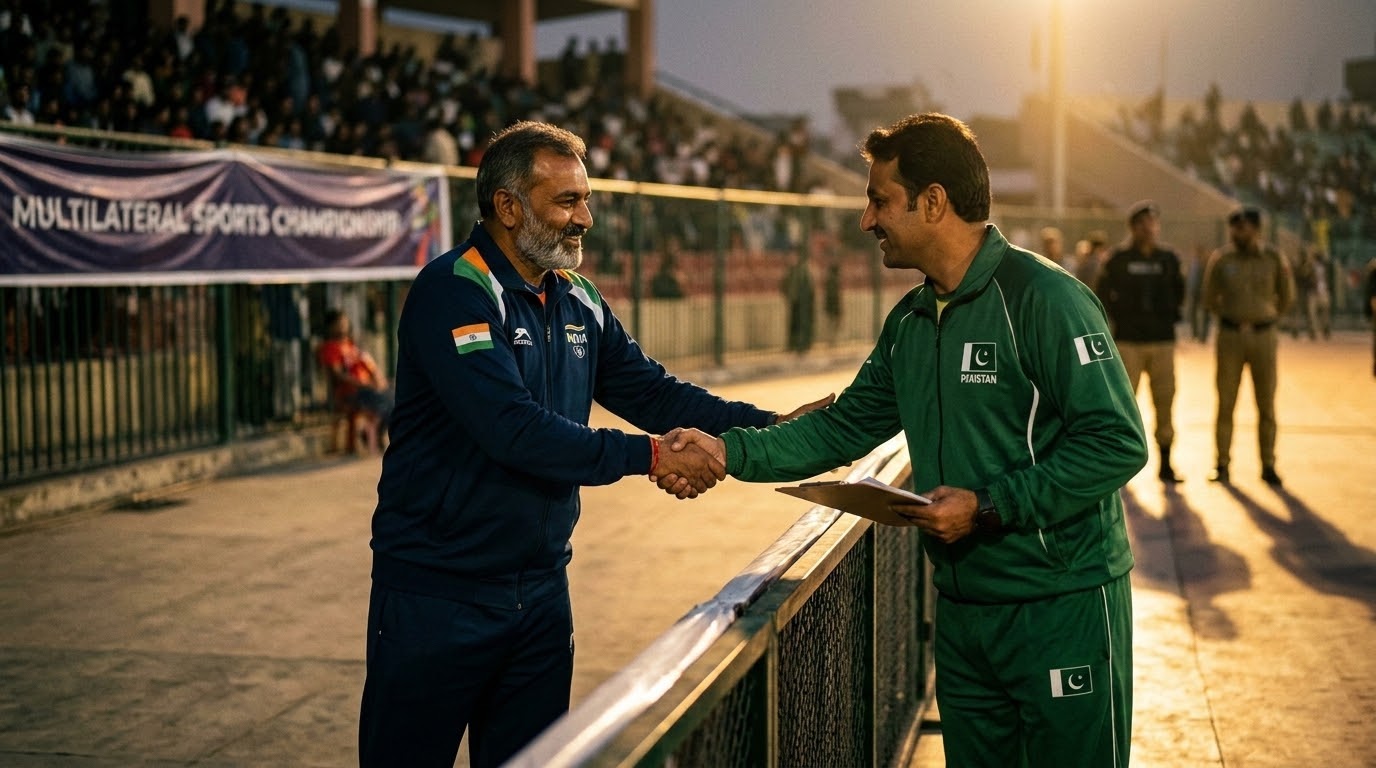
India’s sports ministry announced on Wednesday that Pakistani athletes and teams will be allowed to compete in international and multilateral events hosted by India, while direct bilateral sporting engagements between the two countries will remain barred. The decision is significant as India expands its global hosting ambitions amid persistent political and security tensions with Pakistan.
What Happened
In an official memorandum issued Wednesday, India’s Ministry of Youth Affairs and Sports set out a two-track policy governing sports exchanges with Pakistan. The ministry said participation in international and multilateral competitions, whether held in India or overseas, would follow the norms of global sports federations and the interests of Indian athletes. At the same time, it maintained a strict prohibition on bilateral contests taking place in each other’s territory.
The statement also introduced administrative measures aimed at easing event operations. It said visa procedures for sportspersons and officials would be simplified, and office bearers of international sporting federations would receive multi-entry visas. The ministry linked these steps to India’s growing role as a host nation and the need to align with international expectations for major tournaments.
New Delhi highlighted that it is scheduled to host the 2030 Commonwealth Games and has submitted bids for the 2036 Olympic Games and the 2038 Asian Games in Ahmedabad. Officials framed the updated posture as part of a broader effort to strengthen India’s standing as a reliable venue for high-profile global events while preserving existing restrictions tied to bilateral relations with Pakistan.
Impact & Consequences
The policy is likely to reduce uncertainty for tournament organizers, athletes, and governing bodies that had faced recurring complications over India-Pakistan participation in events connected to India. By clarifying that multilateral competitions can proceed with Pakistani participation, New Delhi signals compliance with international sporting frameworks, a factor that can influence confidence in its capacity to host events at Olympic and continental scale.
At the same time, the continued ban on bilateral competitions underscores that sports normalization remains limited. For athletes and fans in both countries, this means iconic head-to-head series, particularly in cricket, remain unlikely outside global tournaments. Diplomatically, the split approach allows India to avoid direct sporting engagement with Pakistan while reducing the risk of friction with international federations that generally require non-discriminatory participation in sanctioned events.
Background & Context
India and Pakistan have long had a strained sporting relationship shaped by broader political conflict. The two nuclear-armed neighbors came close to a wider war after a military confrontation last year, reinforcing hardline positions across several sectors, including cross-border sports. Bilateral cricket, once a regular feature of the rivalry, has effectively remained frozen, with no full series played since 2012-13.
In recent years, encounters between the two teams have largely been confined to multilateral tournaments and often at neutral sites. During the men’s T20 Cricket World Cup earlier this year, India was listed among hosts, but Pakistan played all of its matches in Sri Lanka, including its group-stage fixture against India. That arrangement reflected both security and diplomatic constraints that continue to shape scheduling and venue decisions for events involving both countries.
International Response
No detailed public reaction from Pakistan was included in the Indian memorandum, but the policy is expected to be watched closely by international sports administrators, especially those overseeing qualification pathways and event hosting standards. Global federations typically emphasize equal participation for member nations in sanctioned competitions, particularly when host countries seek marquee events.
For bodies evaluating India’s bids for the 2036 Olympics and 2038 Asian Games, the visa facilitation pledge for athletes, officials, and governing-body office bearers may be viewed as a practical positive. Event rights holders and tournament planners are also likely to interpret the policy as an attempt to reduce operational risk, even as unresolved bilateral restrictions continue to limit direct India-Pakistan sporting exchanges.
What to Expect Next
Attention will now shift to how the policy is implemented in upcoming international competitions tied to India’s hosting calendar. Sports officials will closely monitor visa processing, team travel protocols, and venue allocations involving Pakistan. The key open question is whether this framework remains stable during periods of heightened political tension, or whether future crises could again force neutral venues, scheduling changes, or last-minute participation disputes.