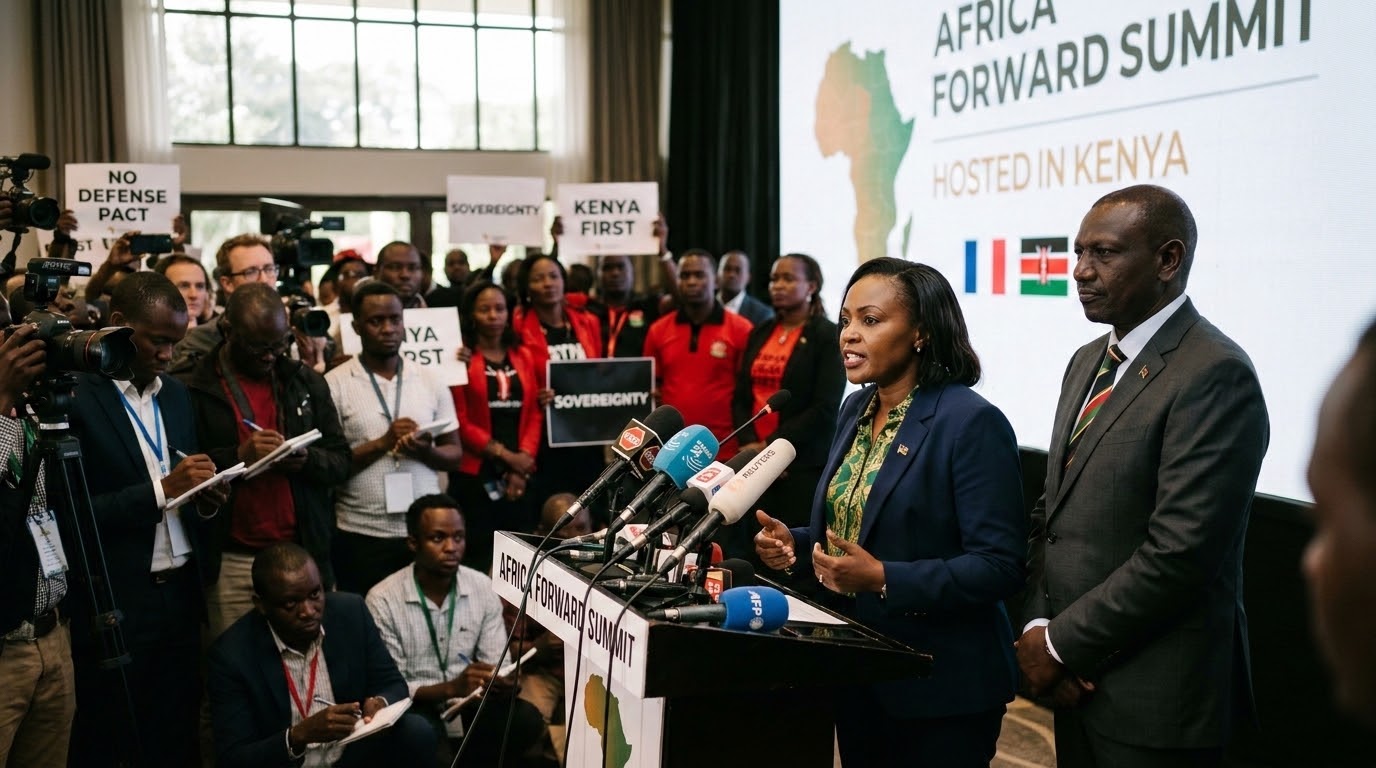
Kenya this week is hosting the Africa Forward 2026 summit with France, the first edition of the gathering to be held outside a Francophone country, as President William Ruto’s government pushes deeper Western partnerships while facing mounting criticism over a new defense pact that opponents say could compromise national sovereignty.
What Happened
The summit brings together African heads of state, policymakers and business leaders, and is being framed by Nairobi and Paris as a strategic reset in economic and security cooperation. For France, the event marks a high-profile move into Anglophone East Africa at a time when its influence has diminished in parts of West Africa. For Kenya, it reinforces Nairobi’s ambition to market itself as a stable regional gateway for global investment and diplomacy.
Its timing is significant. In April 2026, Kenya and France signed a defense cooperation agreement after 800 French troops arrived in Mombasa for joint exercises with the Kenya Defence Forces. Officials later said 600 French military personnel had already been deployed to provide training. The automatically renewable five-year arrangement covers maritime security, intelligence, peace support operations, humanitarian action and disaster response.
The accord has become the focal point of domestic controversy. Critics argue that provisions on legal jurisdiction give France outsized protection, including diplomatic-style immunity and dispute resolution through diplomatic channels rather than local courts. They also cite clauses that allow convicted French personnel to serve sentences in France and give Paris primary jurisdiction over offenses committed by its soldiers in Kenya. Kenyan lawmaker Nelson Koech, who chairs the National Assembly committee overseeing defense, intelligence and foreign relations, rejected claims that blanket immunity was granted, saying serious crimes such as murder must be tried in Kenya.
Impact & Consequences
The Kenya-France alignment could reshape security and commerce in the Western Indian Ocean, a corridor central to shipping, counterterrorism and military positioning. Supporters in government say French training and intelligence cooperation can strengthen Kenya’s response to al-Shabab and complement existing security arrangements with the United Kingdom and the United States, both of which already maintain military footprints in Kenya.
Yet the political cost could be high. Since 2024, Kenya has faced repeated anti-government unrest over economic hardship, policing tactics and press restrictions, and the defense deal is emerging as another flashpoint ahead of budget season. Opponents warn that any move toward a long-term or permanent French troop presence could trigger wider protests. They also argue the pact risks pulling Kenya into disputes driven by external powers. Lawmaker Caleb Hamisi has warned that foreign deployments can turn Kenya into a proxy arena, exposing the country to consequences that do not reflect its own priorities.
Background & Context
The summit reflects broader geopolitical shifts. President Emmanuel Macron has sought to rebuild France’s African partnerships after years of worsening anti-French sentiment in the Sahel and political ruptures in former colonies. Kenya, by contrast, has pursued a multi-partner foreign policy and quickly ratified defense cooperation deals with China, Zimbabwe, the Czech Republic, Ethiopia and France.
Economic ties with Paris have expanded sharply. French investment in Kenya reached 1.8 billion euros, about $2.1 billion, over the past decade, according to Kenyan government data. At least 140 French firms now operate in Kenya, up from 40 in 2013. France is described as one of Kenya’s largest investors and supports roughly 46,000 direct jobs. In March 2026, Business France East Africa and the French Chamber of Commerce in Kenya launched a guide to help French companies navigate opportunities in the country, underscoring Nairobi’s role as a regional business hub.
International Response
Analysts say both sides are trying to move toward more transactional, mutually beneficial partnerships rather than aid-heavy models. Patricia Rodrigues, Africa director at Control Risks, said African and European governments increasingly seek bilateral ties focused on strategic commerce, industrial value and shared security interests. She argued that France views Kenya as a key entry point to East and Southern Africa, while Kenya sees additional defense ties as useful in confronting cross-border militant threats.
At the same time, skepticism remains intense. Macron has faced backlash for earlier remarks in which he said Sahel leaders had failed to thank France and suggested some would not remain sovereign without French military deployments. Critics say such statements reinforce fears that old hierarchies persist beneath new diplomacy. Civil society voices in Kenya and opposition politicians are now calling for stronger parliamentary scrutiny, fuller public disclosure of defense clauses and clearer safeguards for legal accountability.
What to Expect Next
The immediate test will be whether Nairobi can convince the public that implementation of the defense pact remains transparent, limited and consistent with Kenyan law. Parliament is expected to face pressure to review disputed provisions as summit commitments move toward execution. If additional troop arrangements or legal amendments are proposed, they are likely to become a central political issue, shaping both Kenya’s domestic stability and France’s wider strategy in non-Francophone Africa.