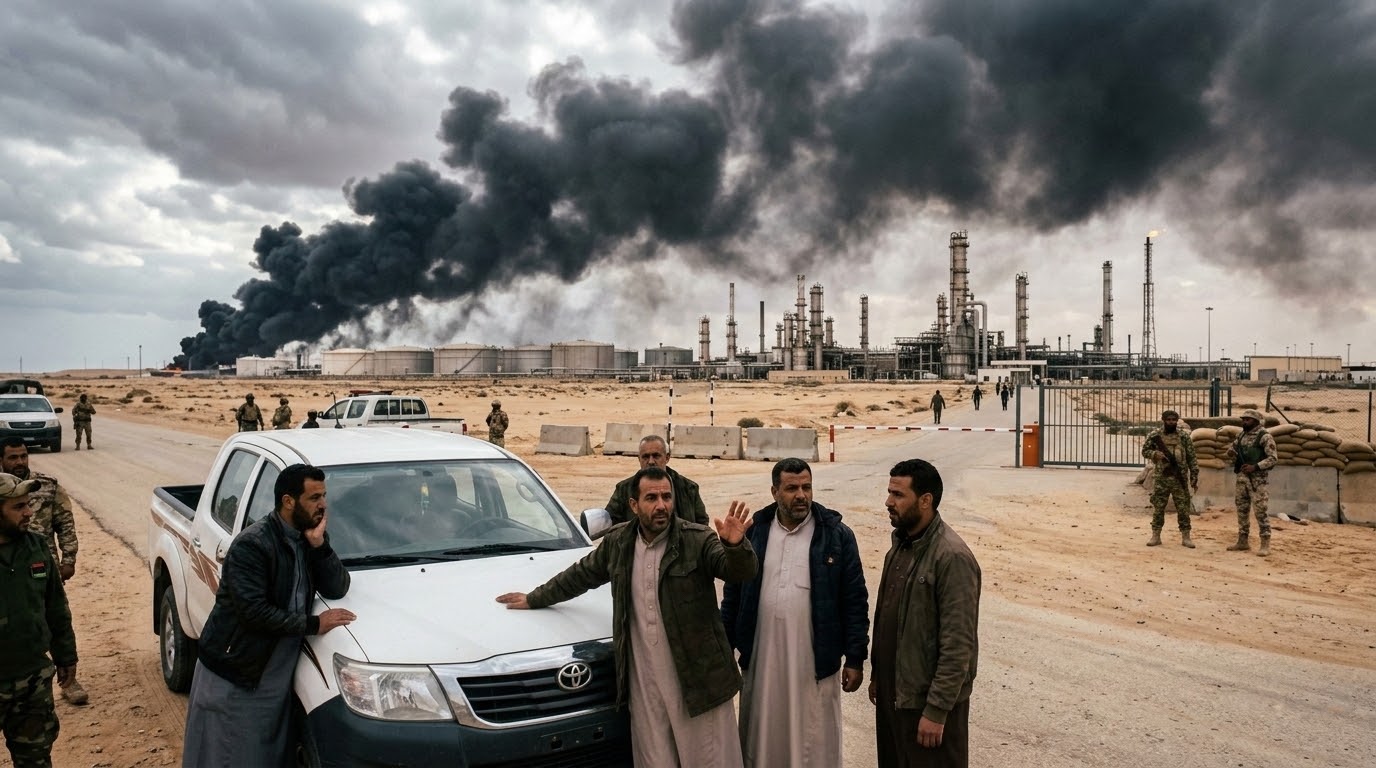
Libya’s largest functioning refinery, in the western city of Zawiya, suspended operations early Friday after nearby fighting escalated into shelling around the facility, prompting an emergency declaration and evacuation. The stoppage matters because the site is central to domestic fuel processing and linked to one of the country’s most important oil-producing fields.
What Happened
The National Oil Corporation (NOC) and the Zawiya Refining Company announced what they described as a precautionary suspension of activity after armed confrontations intensified around the complex. According to statements released by the companies, workers were evacuated from both the refinery and the adjacent port area as a safety measure while sirens were activated.
In a public statement posted on social media, refinery authorities said clashes involving heavy weaponry began in the early hours of Friday. They reported that several projectiles landed at different points inside the industrial site. Officials said no major structural damage had yet been confirmed, but warned that hostilities had moved closer to nearby residential neighborhoods, sharply raising risks to personnel and infrastructure.
Local authorities in Zawiya, roughly 40 kilometers west of Tripoli, said they had launched a broad security campaign against criminal networks. They said the operation targeted hideouts and wanted suspects linked to serious offenses, including homicide, kidnapping, extortion, narcotics trafficking, arms smuggling, human trafficking, and irregular migration. Media footage verified by regional broadcasters showed explosions, sustained gunfire, and damaged vehicles and installations within refinery grounds.
Impact & Consequences
The immediate consequence is the temporary loss of output from a facility with refining capacity of 120,000 barrels per day, a significant volume for Libya’s domestic fuel system. The Zawiya site is also connected to the Sharara oilfield, which can produce around 300,000 barrels daily, making the area strategically vital for the broader oil chain from production to processing and distribution.
While NOC said all staff were safe and maintained that fuel deliveries would continue normally, a prolonged interruption could increase pressure on supply logistics and heighten concerns among traders and international buyers about Libyan reliability. The incident also highlights a recurring pattern in Libya: energy infrastructure remains vulnerable to sudden disruptions when local security operations overlap with rival armed actors. Refinery management has urged all sides to stop fighting immediately and called for stronger state protection of critical facilities and civilian zones.
Background & Context
Libya’s oil and gas sector has repeatedly been caught in the crossfire since the 2011 overthrow of Muammar Gaddafi. Despite periods of increased output, political fragmentation and militia competition have frequently led to shutdowns, blockades, and force majeure declarations. Even when front lines are relatively stable, localized clashes can quickly endanger pipelines, export terminals, and processing plants.
The country remains divided between the Tripoli-based Government of National Unity led by Prime Minister Abdul Hamid Dbeibah and a rival administration in the east aligned with military commander Khalifa Haftar, which lacks international recognition. Although the precise trigger for Friday’s violence remains unclear, local reporting indicates the confrontation began during a security sweep targeting armed groups in and around Zawiya. The episode underscores how anti-crime operations in contested urban environments can spill into strategic industrial areas.
International Response
No major foreign government had announced a formal intervention at the time of reporting, but the shutdown is likely to be watched closely by diplomatic missions, energy importers, and international institutions tracking Mediterranean supply security. Libya is a key crude supplier to parts of Europe, and any instability around processing and export corridors tends to draw rapid attention from market analysts and regional policymakers.
Energy observers have emphasized that even short-lived stoppages in Libya can reverberate beyond immediate output figures, especially when they involve nodes tied to major upstream fields. The latest incident is expected to reinforce longstanding calls by international partners for unified security command structures and stronger protection protocols around oil infrastructure, particularly in western Libya where armed formations remain active near densely populated districts.
What to Expect Next
In the near term, attention will focus on whether security forces can contain fighting around Zawiya and enable a safe restart at the refinery and port. NOC’s pledge to maintain fuel supply will be tested if the suspension extends. Key unresolved questions include who controls the surrounding areas after the operation, whether retaliatory clashes continue, and how quickly authorities can prevent further strikes near strategic energy facilities.