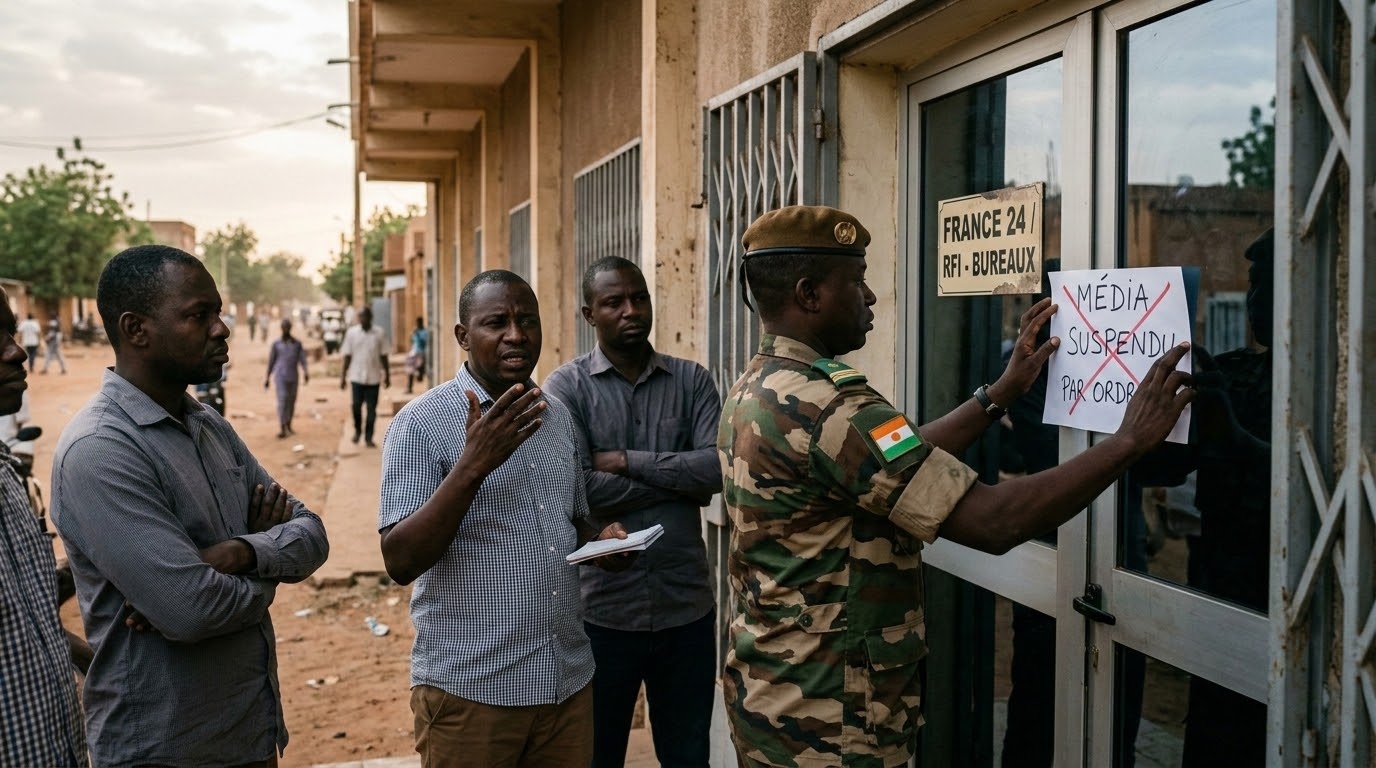
Niger’s military government has ordered the immediate suspension of nine French media organizations, a move announced Friday that rights groups say marks a major escalation in the country’s press crackdown. The decision matters beyond Niger, as it reflects a wider tightening of information control among military-led Sahel governments.
What Happened
In a televised statement, Niger’s National Communication Observatory (ONC) said the outlets were suspended for repeatedly distributing material deemed likely to threaten public order, national unity, social cohesion and institutional stability. The ban applies at once and covers satellite services, cable systems, digital platforms, websites and mobile applications, greatly expanding the reach of the restrictions.
The affected organizations are France 24, Radio France Internationale (RFI), France Afrique Media, LSI Africa, Agence France-Presse (AFP), TV5 Monde, TF1 Info, Jeune Afrique and Mediapart. The decision targets television channels, radio, wire services and online publications in one of the broadest recent media actions by Niger’s authorities.
Reporters Without Borders (RSF) denounced the measure as abusive and described it as part of a coordinated effort to curb press freedom within the Alliance of Sahel States (AES), which includes Niger, Mali and Burkina Faso. Niger has been under military rule since July 2023, when soldiers ousted President Mohamed Bazoum. Since then, authorities have repeatedly sanctioned domestic and foreign media critical of state policy.
Impact & Consequences
The latest suspensions further narrow access to independent international reporting for people inside Niger and reinforce state influence over the information space. By blocking major French-language broadcasters and news providers across multiple delivery channels, the government can more effectively shape public narratives on security operations, governance and relations with foreign partners.
The decision also carries diplomatic weight. France-linked media have been frequent targets as Niamey distances itself from Paris and other Western partners. Restrictions on global agencies such as AFP may complicate external coverage of events inside Niger, reducing transparency for investors, aid actors and multilateral institutions. For local journalists, the move adds to an atmosphere of legal and professional risk amid arrests, detentions and broad public-order provisions increasingly applied to media activity.
Background & Context
Media pressure in Niger has intensified steadily since the 2023 coup. RFI and France 24 were suspended within days of the military takeover, and the BBC was suspended in December 2024. Authorities have paired these actions with legal measures, including a tougher 2024 framework criminalizing digital distribution of information considered likely to disturb public order.
The clampdown has unfolded alongside a strategic realignment in the Sahel. Niger, Mali and Burkina Faso have all reduced ties with France, criticized what they call French interference, and sought new defense arrangements, notably with Russia. In late 2023, Niger requested the withdrawal of French troops involved in regional counter-armed-group missions. According to AFP, Niamey also suspended nearly 3,000 local and foreign NGOs in 2025, accusing them of opacity and links to armed actors. RSF says Niger fell 37 places in its latest World Press Freedom Index, ranking 120th of 180 countries.
International Response
RSF publicly called for an immediate reversal of the suspensions and warned that restrictions across AES countries are increasingly synchronized. Amnesty International has also repeatedly raised concern over what it describes as a sustained decline in freedom of expression and independent journalism in Niger.
The United Nations reported in November that 13 journalists had been arrested in Niger and urged authorities to release them. Local media groups say six journalists remain detained on accusations including undermining national defense and conspiring against state authority. Two Nigerien journalists, Gazali Abdou, a correspondent for Deutsche Welle, and regional editor Hassane Zada, were released this week after months in detention, but their cases have not eased broader concern over press intimidation.
What to Expect Next
Attention is now likely to focus on whether Niger’s authorities formalize longer-term legal actions against the suspended outlets or revisit the decision under external pressure. Regional observers will also watch Mali and Burkina Faso for comparable steps, given RSF’s warning of coordinated restrictions. For now, journalists and rights advocates expect continued legal uncertainty, tighter controls on digital publishing and further disputes over sovereignty, security and media independence.