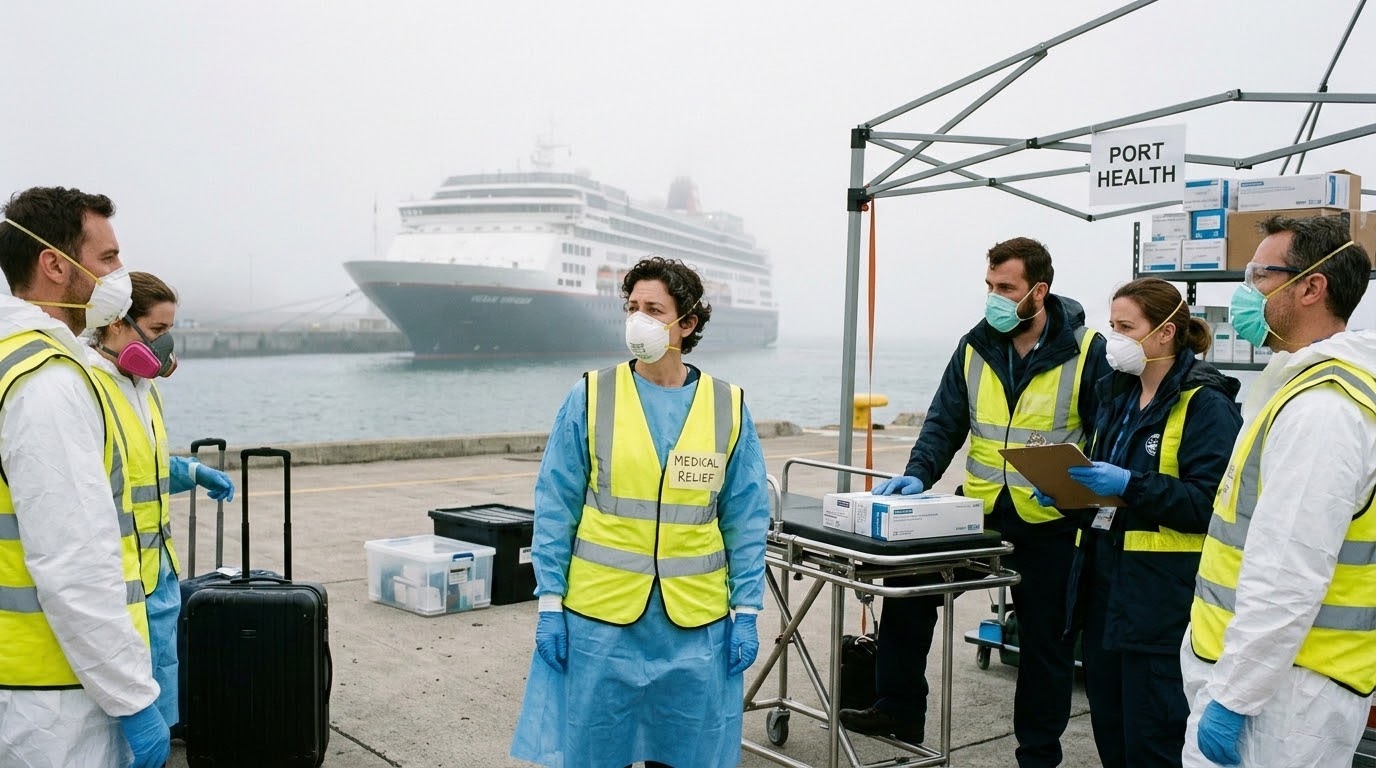
Spanish health and security teams are preparing to receive the MV Hondius off Tenerife before dawn on Sunday, nearly a month after the first onboard hantavirus death, in an operation officials call unprecedented. The plan is designed to move more than 100 people safely ashore and prevent any wider spread of the Andes strain.
What Happened
The cruise vessel, carrying passengers and crew affected by a prolonged health emergency, is approaching the Canary Islands after weeks at sea. Authorities said the ship would not be allowed to dock directly. Instead, a one-nautical-mile exclusion zone is being enforced as it nears Tenerife, and it is expected to remain anchored offshore in the port area of Granadilla to maintain isolation during transfer procedures.
By around 07:00 local time on Sunday (06:00 GMT), medical teams are expected to board and assess everyone on board for possible symptoms. Latest official updates indicate no additional suspected cases at this stage. After medical checks, those disembarking will be organized by nationality and moved in small boats to shore, where charter aircraft are due to be waiting at a nearby airport for repatriation flights.
Spain’s interior ministry said the United Kingdom, the United States and several European Union member states are deploying aircraft. Medically equipped planes are also on standby for emergency transfers if any traveler requires strict isolation. Spanish nationals are expected to be flown to Madrid, where mandatory quarantine has been arranged at the Gomez Ulla military hospital. Authorities have not yet confirmed the exact duration of quarantine in each jurisdiction, though the incubation period can extend to nine weeks.
Impact & Consequences
The operation has immediate implications for public health management, emergency logistics and public confidence in crisis communication. Spanish officials have repeatedly said the threat to the broader population remains low, but they have combined that message with visibly strict controls, including military police presence, restricted waterfront access and temporary reception infrastructure in Tenerife’s industrial port zone.
The response also carries political sensitivity in the Canary Islands, where regional leaders and residents voiced concern over the decision to route the ship there. The president of the Canary Islands has said he will not feel calm until all passengers and crew have departed. Public anxiety has been shaped by the memory of the Covid-19 pandemic, making transparent risk messaging central to authorities’ strategy. For those onboard, the end of maritime confinement marks only a transition into potentially lengthy land-based quarantine and medical monitoring.
Background & Context
The outbreak has been linked to a landfill area at Argentina’s southern tip, a location frequented by birdwatchers. The virus involved is the Andes variant of hantavirus, carried by rodents in that region. Human-to-human transmission is uncommon, but health agencies moved aggressively after three passengers died, reflecting the severity of illness that can occur in some cases.
For Spain, the Hondius transfer has become a test of preparedness for low-probability but high-consequence infectious threats. Intensive care capacity has been readied at Candelaria hospital in Tenerife, where specialist teams are on standby. Hospital officials said a dedicated high-isolation bed is fully equipped with ventilation support and diagnostic tools, and staff have prepared large quantities of protective equipment. Local doctors acknowledged they have not previously treated hantavirus cases directly but said teams are trained for complex viral respiratory emergencies.
International Response
The World Health Organization has taken an unusually visible role in the disembarkation phase. WHO Director-General Tedros Adhanom Ghebreyesus traveled to Tenerife and publicly commended Spain’s handling of the incident, describing the response as robust and effective. He also sought to reassure residents, acknowledging that pandemic-era trauma has heightened fear but saying current risk assessments point to low likelihood of broader community spread.
The multinational airlift underscores cross-border coordination rarely seen in routine maritime incidents. With 23 countries involved, governments have had to align health screening, transport protocols and quarantine rules under time pressure. Spain’s health minister, Mónica García, has warned against misinformation and alarmism, arguing that clear public communication is essential to preserving trust while operational decisions are carried out under strict containment rules.
What to Expect Next
In the coming hours, the key phase will be medical screening and staggered transfer from ship to shore, followed by onward flights. Around 30 crew members are expected to remain aboard to sail the vessel back to the Netherlands. For disembarked passengers and crew, attention will shift to quarantine enforcement, symptom surveillance and possible further isolation decisions as national authorities monitor for late-emerging cases over the coming weeks.