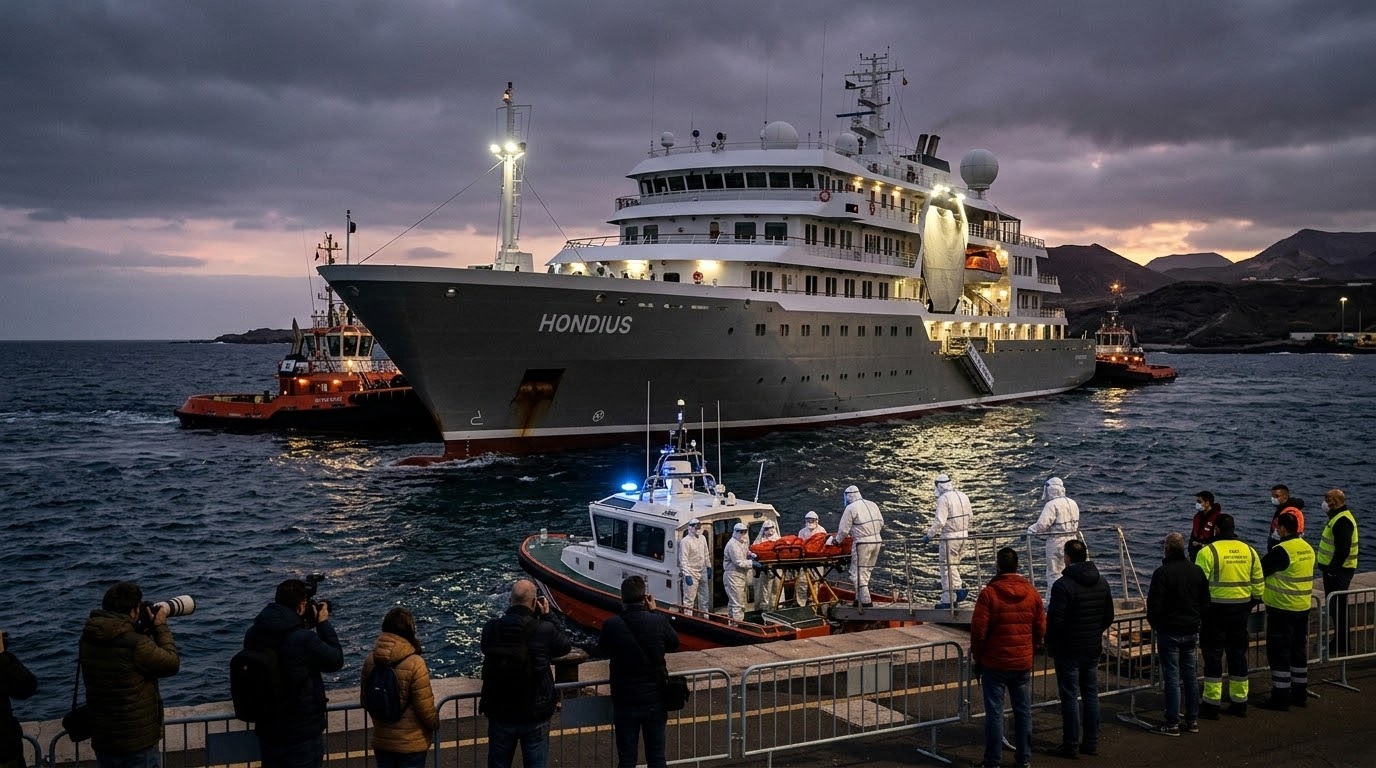
Spain has authorized the Dutch-flagged cruise ship MV Hondius, linked to a deadly hantavirus outbreak, to proceed to the Canary Islands after remaining offshore near Cape Verde, a move announced late Tuesday that creates a critical evacuation route for 147 people from 23 countries and triggers a multinational public-health response.
What Happened
Spain’s Health Ministry said the decision followed guidance from the World Health Organization that Cape Verde lacked the capacity to receive all passengers and crew members safely. In its statement, Madrid said the Canary Islands were the nearest location with adequate medical and logistical capability, adding that Spain had both legal and humanitarian responsibilities to assist, including for Spanish nationals on board.
The ship’s operator, Oceanwide Expeditions, has reported urgent medical needs among those still at sea. According to the company, two crew members require immediate care, while another suspected case has so far shown only mild fever. Spanish authorities also said they would receive a medical flight transporting the ship’s doctor, a Dutch citizen described as critically ill, after a formal request from the Netherlands.
The outbreak has already claimed three lives: a Dutch man, his Dutch wife, and a German national. A British passenger evacuated earlier is in intensive care in Johannesburg, where South African officials confirmed a positive hantavirus test. Oceanwide said the vessel’s transit to either Gran Canaria or Tenerife would take about three days. Once arrivals begin, Spain said evacuees will be examined, treated, and then repatriated in coordination with European and global health agencies.
Impact & Consequences
The decision shifts the crisis from an offshore containment problem to a tightly managed public-health operation on European territory. Spanish officials said medical transfers and onward transport would use dedicated facilities and specialized vehicles to minimize contact with local residents and protect healthcare workers, reflecting concern over transmission in confined settings despite low risk to the broader public.
For governments involved, the incident has immediate diplomatic and operational implications. Nationals from more than 20 countries are affected, requiring synchronized consular support, medical triage, and cross-border travel arrangements. The Dutch government has already said it is preparing to receive evacuated passengers. The situation also places scrutiny on expedition-cruise biosecurity protocols, emergency planning for remote routes, and preparedness for outbreaks that emerge far from major ports.
Background & Context
The MV Hondius departed Ushuaia, Argentina, on April 1 for Cape Verde with 88 passengers and 59 crew, according to the WHO. The luxury voyage, marketed as an Antarctic wildlife expedition with berths priced between 14,000 and 22,000 euros, included stops at the Antarctic Peninsula, South Georgia, and Tristan da Cunha, along with bird-watching excursions to isolated islands.
Hantavirus is typically associated with exposure to infected rodent secretions, including urine, droppings, and saliva. WHO officials said there were reports of no rats aboard the vessel, suggesting some infections may have occurred before embarkation or during shore activities where rodents were present. The agency noted an incubation period of roughly one to six weeks and said it believes the Dutch couple had likely been infected while in Argentina before boarding. Limited person-to-person spread has previously been observed in outbreaks involving the Andes strain in South America.
International Response
WHO has taken a central coordination role, working with the ship operator and national authorities to manage evacuation and follow-up surveillance. Maria Van Kerkhove, the organization’s director for epidemic and pandemic preparedness and prevention, said in Geneva that investigators suspect some uncommon human-to-human transmission among very close contacts, such as cabin-sharing couples. She also emphasized that overall risk to the general public remains low.
The European Centre for Disease Prevention and Control is coordinating with Spain on screening and repatriation protocols, while South African health authorities continue to monitor the confirmed British case in Johannesburg. WHO said contact tracing is under way for passengers linked to previous evacuation flights, including those associated with the Dutch woman who became severely ill during transfer and later died in South Africa.
What to Expect Next
Over the coming days, the immediate focus will be the ship’s arrival in the Canary Islands, rapid assessment of all remaining passengers and crew, and prioritized evacuation of severe cases. Health authorities are expected to publish further updates on confirmed infections, tracing outcomes, and repatriation timelines. A key unresolved question is whether additional transmission occurred on board or whether most cases originated from earlier land exposures during the voyage.