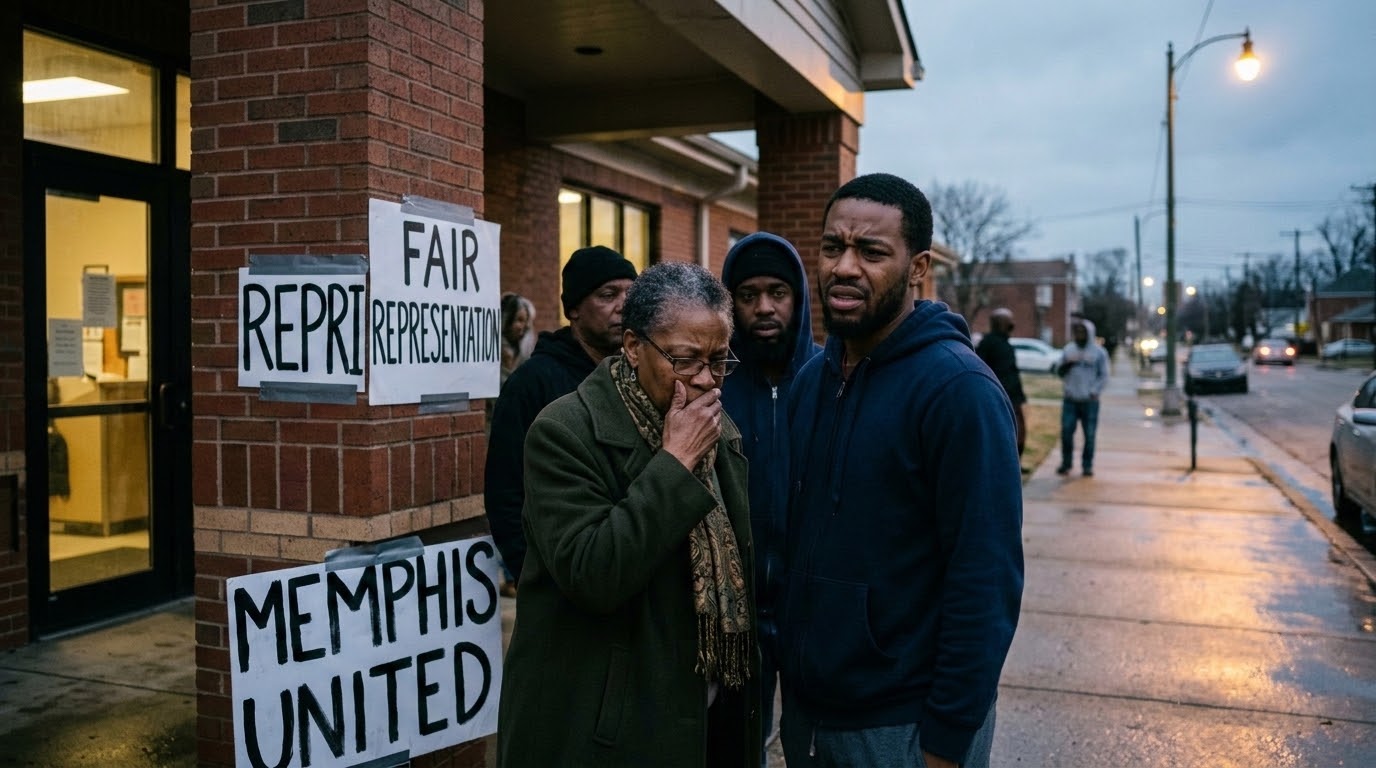
Tennessee’s Republican-led legislature and Governor have approved a new congressional map that dismantles the state’s sole Black majority US House district, a decision finalized on Thursday ahead of November’s midterm elections. The change could reshape representation in Memphis and reflects a broader national struggle over partisan map-drawing and minority voting power.
What Happened
The redistricting plan passed by Tennessee lawmakers breaks apart the only district currently represented by a Democrat, anchored in Memphis, a city with a large Black population. Opponents in the statehouse said the lines were crafted to spread Black voters across multiple districts, reducing their collective influence in any single race. Supporters argued the plan was a standard political exercise focused on population balance and electoral strategy.
Democratic state Representative Justin Pearson condemned the maps in sharply racial terms, saying they were designed to serve white supremacist politics and accusing former President Donald Trump of driving that agenda nationally. Outside the legislature, demonstrators carried signs labeling the effort “Jim Crow,” invoking the era of legal racial segregation in the American South. Republican House Speaker Cameron Sexton rejected allegations of racial targeting, saying lawmakers relied on population and political considerations rather than race data.
Republican state Senator John Stevens openly described the proposal as an attempt to improve his party’s position, stating that redistricting to strengthen partisan outcomes is common across the United States. The Tennessee vote comes during a multistate rush to redraw district boundaries before midterms, despite redistricting traditionally occurring once every decade after the national census.
Impact & Consequences
The immediate effect in Tennessee is likely to be a steeper path for Democrats to retain influence in the state’s congressional delegation. By dividing the Memphis-centered district, Republicans may increase their odds of winning additional seats in a state that already leans strongly to the GOP. For Black voters in Shelby County and surrounding areas, critics say the practical consequence could be diminished capacity to elect candidates preferred by their communities.
Nationally, the Tennessee decision adds momentum to an escalating redistricting contest that could help determine control of the 435-member US House of Representatives. While forecasters still assess that a majority of districts nationwide currently lean Democratic, Republicans have gained more seats than Democrats in this latest map-redrawing cycle. That shift may tighten the margin in a chamber where even a handful of seats can decide legislative power, committee control, and the future of federal policy on voting, spending, and oversight.
Background & Context
Congressional boundaries are usually redrawn after the decennial US census, but both parties in multiple states have recently pursued mid-decade revisions to gain tactical advantages before voters return to the polls. The latest wave accelerated after Trump urged Republicans in Texas to redesign districts to create five more GOP-friendly House seats. Since then, legislatures in Missouri, California, Utah, Ohio, North Carolina, Virginia, and Texas have also moved to revisit congressional maps.
The political stakes rose further after a US Supreme Court ruling last week invalidated a key part of the 1973 Voting Rights Act that had been used to challenge maps seen as weakening minority electoral power. Under the new legal standard, plaintiffs must show mapmakers intentionally sought to disenfranchise minority voters. Voting-rights advocates argue that proving intent is far more difficult than demonstrating discriminatory effects, potentially making successful legal challenges rarer and slower.
International Response
There has been no major formal intervention from foreign governments, but the Tennessee action is being watched internationally as part of a broader debate over democratic institutions in the United States. Global democracy researchers and civil-rights observers have long tracked US redistricting disputes as indicators of electoral fairness, minority representation, and confidence in rule-of-law protections.
Domestic advocacy groups, whose findings are often cited by international election monitors, warn that the combined impact of mid-cycle map changes and the Supreme Court’s decision could reduce safeguards for minority communities. Meanwhile, state officials in places including Louisiana and Alabama are reassessing their own district maps, signaling that Tennessee may not be the final flashpoint. Louisiana has already paused House primaries while pursuing new boundaries, and Alabama is also seeking revisions before November.
What to Expect Next
Attention now shifts to whether Tennessee’s map faces court challenges and whether additional states redraw boundaries before ballots are cast. With primary calendars and candidate strategies already in motion, any legal disputes will unfold under tight deadlines. The larger unresolved question is how many seats this redistricting surge will ultimately move between parties, and whether those shifts will be enough to alter control of Congress after the midterms.