The World Health Organization said Thursday that a hantavirus outbreak linked to the Dutch cruise ship MV Hondius in the South Atlantic does not represent the start of a new pandemic, even as health agencies investigate three deaths and track passengers dispersed across several countries. The agency stressed the virus spreads differently from Covid-19 and currently poses a low global risk.
What Happened
At a WHO briefing, infectious disease specialist Maria Van Kerkhove said five of eight suspected infections tied to the vessel had been laboratory confirmed. She emphasized that hantavirus transmission in this event appears to require close personal contact, unlike respiratory viruses that spread rapidly through casual interaction. WHO Director-General Tedros Adhanom Ghebreyesus said the organization’s present assessment is that the broader public health threat remains low.
The MV Hondius, operated by Oceanwide Expeditions, departed Ushuaia, Argentina, on 1 April with roughly 150 passengers and crew from 28 countries. Dozens later disembarked on St Helena, a remote British Overseas Territory, on 24 April. Authorities have issued differing figures: Oceanwide reported 29 people left the ship there, while Dutch officials cited 40, including a Swiss passenger now confirmed positive. Seven were British nationals, according to UK authorities.
Three deaths have been reported in connection with the voyage: a 69-year-old Dutch woman who tested positive and later died in South Africa, her Dutch husband who died aboard on 11 April, and a German woman who died on board on 2 May. The latter two are not yet confirmed hantavirus cases. WHO also said this cluster included documented person-to-person transmission, a significant finding because hantavirus is typically associated with rodent exposure.
Impact & Consequences
The immediate consequence is a complex multinational contact-tracing operation involving public health agencies, airlines, cruise operators, and border authorities. Because hantavirus can incubate for up to six weeks, officials expect additional suspected cases may appear even after passengers have returned home. That timeline has widened surveillance windows and increased pressure on health systems to monitor asymptomatic travelers across multiple jurisdictions.
The outbreak has also exposed operational vulnerabilities in expedition cruising, where passengers from many countries move through isolated ports with limited healthcare infrastructure. St Helena, where many passengers left the ship, has a population of about 4,400 and a single hospital. Governments are now balancing targeted containment measures against overreaction, especially after WHO drew a clear distinction from Covid-era pandemic dynamics. For travelers, the event may lead to stricter onboard infection-control protocols, expanded pre-disembarkation screening, and more formal cross-border health notification procedures.
Background & Context
Hantavirus infections are usually linked to contact with rodents or contaminated environments, and severe cases can lead to life-threatening disease. In this incident, WHO said the first two confirmed patients had traveled through Argentina, Chile, and Uruguay on a bird-watching trip that included places inhabited by rat species known to carry the virus. Argentine health authorities have since said they will test rodents in Ushuaia, where the voyage began.
Unlike influenza or SARS-CoV-2, hantavirus has not historically been associated with sustained global transmission chains. That distinction underpins WHO’s current risk assessment. Even so, the combination of severe outcomes and international travel has revived concern over delayed detection in mobile populations. Oceanwide said the first confirmed onboard case was reported only on 4 May, after some passengers had already disembarked in St Helena, complicating early containment and prompting retrospective tracing through flights and onward travel routes.
International Response
National agencies have moved quickly to identify and monitor exposed travelers. The UK Health Security Agency said two British nationals are self-isolating in the UK, four remained in St Helena, and tracing continued for a seventh person. In Singapore, the Communicable Diseases Agency said two men who disembarked in St Helena were isolated and tested after sharing a flight to Johannesburg with the Dutch woman who later died; results were pending.
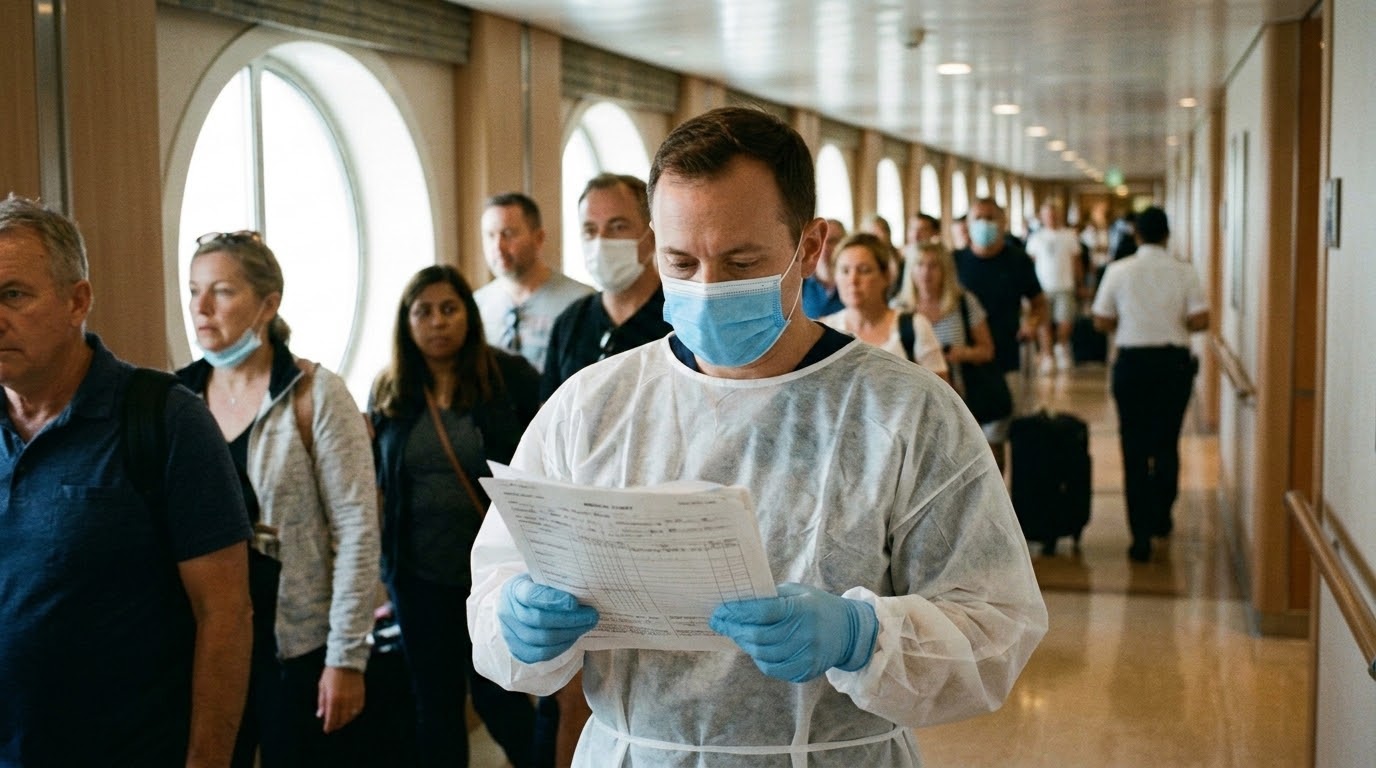
In the United States, officials in Georgia and Arizona said they were monitoring three returning passengers, none of whom showed symptoms. The U.S. State Department said it was in direct contact with affected travelers. Dutch authorities are also contacting passengers from a KLM service in Johannesburg after the infected Dutch woman became unwell before departure. WHO has advised mask use on board the vessel and enhanced protective equipment for those caring for suspected cases.
What to Expect Next
Health agencies are likely to report more suspected infections as the six-week incubation window progresses and laboratory testing catches up. Investigations will focus on unresolved fatalities, potential transmission chains after disembarkation, and rodent-related exposure points in South America. The MV Hondius, expected in the Canary Islands, remains under close scrutiny as authorities coordinate quarantine, screening, and final disembarkation protocols for passengers and crew.