Global health authorities are urgently tracing former passengers of the Dutch cruise vessel MV Hondius after a hantavirus outbreak left five confirmed infections and three deaths. The World Health Organization said the multi-country effort matters because some travelers disembarked before the first case was identified, creating potential chains of exposure across several continents.
What Happened
The outbreak was identified after passengers and crew from the expedition cruise began showing symptoms during and after the voyage, which departed Ushuaia, Argentina, on 1 April and is due to end in the Canary Islands. About 150 people from 28 countries were initially on board, but dozens got off at St Helena on 24 April, days before the first laboratory-confirmed case was reported on 4 May. The WHO said the incubation period can extend to six weeks, meaning additional infections cannot be ruled out.
According to the WHO, documented person-to-person transmission has occurred in this outbreak, a significant development for hantavirus, which is usually associated with rodent exposure. The agency said this does not resemble the early phase of Covid-19, describing spread as linked to close, intimate contact rather than broad community transmission. Still, officials are monitoring contacts across at least 12 countries: Canada, Denmark, Germany, the Netherlands, New Zealand, Saint Kitts and Nevis, Singapore, Sweden, Switzerland, Turkey, the United Kingdom and the United States.
Country-level investigations continue to expand. In the UK, two men have confirmed infections, including 56-year-old retired police officer Martin Anstee, evacuated to the Netherlands in stable condition. Another British patient was flown to South Africa and remains in intensive care. French authorities identified eight people who had contact with a Dutch woman who later died; one developed mild symptoms and was awaiting test results. Swiss officials confirmed one positive case in a man who left the ship in St Helena and was tested in Zurich. US state health departments said they were monitoring exposed individuals in Georgia, Texas, Arizona, Virginia and California, with no symptoms reported at the time of notice.
Impact & Consequences
The immediate consequence is a complex international contact-tracing operation involving remote islands, long-distance flights and multiple health systems. Authorities must identify and monitor people who interacted with former passengers, including those now in isolated territories such as Tristan da Cunha and St Helena. Medical support teams are expected to be sent to some locations because local healthcare capacity is limited. The combination of delayed symptom onset and multinational travel has made case management highly resource-intensive.
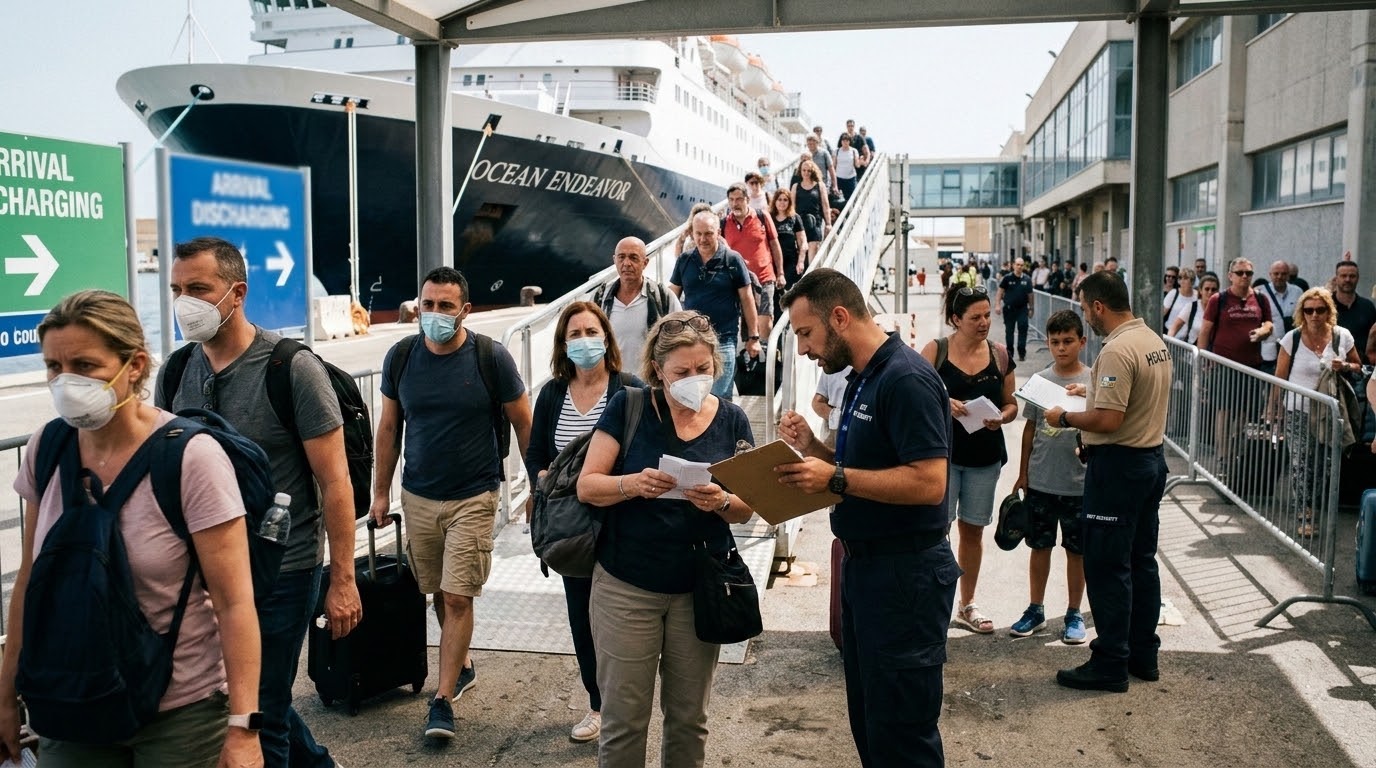
The incident is also creating political and logistical strain around port access and repatriation. The MV Hondius was unable to dock as planned in a West African archipelago and remained offshore before heading toward Tenerife. While Spain authorized arrival and medical assessment, Canary Islands President Fernando Clavijo publicly opposed the move, saying regional officials had insufficient information. Residents in Tenerife voiced concern about possible local risk, even as health bodies emphasized that broader public danger remains low.
Background & Context
Hantavirus infections are typically linked to contact with infected rodents or their droppings. In this event, WHO investigators noted that a Dutch couple had taken a birdwatching tour across Argentina, Chile and Uruguay before boarding, including areas where rodents associated with the Andes strain are found. The source has not been conclusively established, and Argentine authorities are examining whether infections may have originated there.
The outbreak has involved severe outcomes. The three reported deaths include two Dutch nationals, a husband and wife, and a German passenger. One of the Dutch victims died after testing positive in South Africa. The German woman developed fever on 28 April and later showed pneumonia-like symptoms, according to WHO information. Dutch media separately reported a KLM flight attendant hospitalized in Amsterdam after possible exposure; a WHO official later told CBS she tested negative. The vessel currently carries 146 people from 23 countries as it approaches Spain.
International Response
The WHO is coordinating with national health authorities to align testing, isolation guidance and monitoring protocols for contacts. Public health messages have focused on proportional risk communication: vigilance for exposed individuals, but no evidence of pandemic-level spread. Experts cited by the BBC described parts of the response as chaotic and poorly coordinated, reflecting the difficulty of managing infections that cross jurisdictions before diagnosis is confirmed.
Governments are taking tailored measures based on passenger nationality and location. Spain plans medical screening on arrival in Tenerife, after which non-Spanish nationals who remain healthy are expected to be repatriated, while 14 Spanish passengers are slated for quarantine in a military hospital in Madrid. The Philippines, which has 38 crew members aboard, said no domestic cases had been recorded and assessed national risk as extremely low.
What to Expect Next
The next critical phase will be disembarkation and clinical assessment in Tenerife, followed by country-by-country follow-up during the remaining incubation window. Health agencies are likely to publish updated case counts as test results return from Europe, Africa and North America. Key unanswered questions include the definitive origin of the outbreak, whether any secondary transmission occurred after disembarkation, and how quickly exposed travelers can be safely cleared for normal travel.