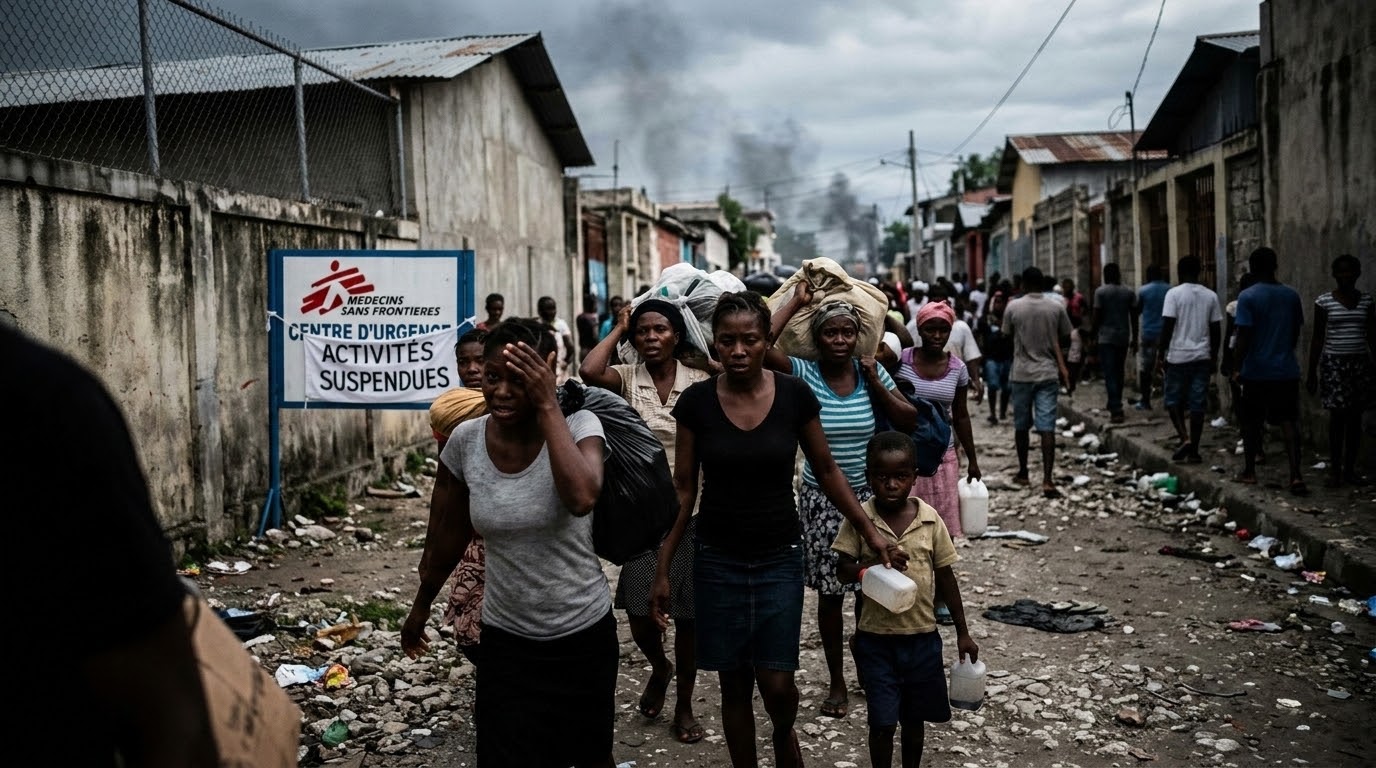
Doctors Without Borders suspended medical operations in parts of Port-au-Prince on Monday after intensified gang fighting in the Cite Soleil area forced hundreds to flee and pushed hospitals to close, underscoring the deepening collapse of essential services in Haiti’s capital as civilians face mounting danger and sharply reduced access to care.
What Happened
Medecins Sans Frontieres (MSF), also known as Doctors Without Borders, said roughly 800 residents sought shelter inside its hospital compound in Cite Soleil before the organization halted activities. In a public statement, MSF said that active gunfire around health facilities made normal operations impossible and that it could no longer assure the safety of patients or staff. The group reported that a security guard inside the compound was hit by a stray bullet, an incident that highlighted how close the fighting had moved to medical sites.
The aid organization said no hospital remained open in the zone where clashes were unfolding. Another facility in the neighborhood, Hopital Fontaine, told Reuters it had evacuated newborns from intensive care as violence escalated. MSF said it received transferred patients from that hospital, including pregnant women who delivered overnight, illustrating the pressure on remaining emergency care pathways even as front-line providers scaled back operations.
The displacement crisis widened over the weekend, with families leaving neighborhoods affected by arson and armed attacks. Some moved toward roads leading to Toussaint Louverture International Airport, using open roadside spaces as temporary refuge. Speaking to the Associated Press, 56-year-old Monique Verdieux said she was sleeping in the street after witnessing gunmen burn buildings near her home and fearing a return would put her life at risk.
Impact & Consequences
The immediate consequence is a severe healthcare vacuum in one of Haiti’s most volatile urban districts. With hospitals shut or partially evacuated, trauma victims, pregnant women, and critically ill children face delayed treatment or dangerous transfers through conflict zones. Medical interruptions in dense, impoverished neighborhoods typically increase preventable deaths, while crowding displaced families into informal shelters raises risks of disease and malnutrition.
The closure also carries broader governance and security implications. Humanitarian groups rely on minimal access guarantees to function; when those guarantees disappear, aid delivery contracts rapidly. That further erodes public trust in state authority and international stabilization efforts, particularly as gangs tighten territorial control. For civilians, the loss of hospital access is not an isolated service failure but part of a wider breakdown in protection, mobility, and basic urban life.
Background & Context
Port-au-Prince has seen expanding gang dominance since the 2021 assassination of President Jovenel Moise, a political shock that accelerated institutional paralysis and security fragmentation. Armed groups now exert effective control over large sections of the capital, and recurring clashes between rival factions have produced repeated mass displacement events, killings, and attacks on public infrastructure.
Authorities have struggled to reverse this trajectory. Attempts to curb gang power have repeatedly failed to produce lasting security gains, leaving neighborhoods trapped in cycles of violence and reprisal. Human rights organizations and relief agencies have for months warned that insecurity is compounding a humanitarian emergency marked by food shortages and shrinking access to healthcare, education, and safe shelter. The latest fighting in Cite Soleil fits that longer pattern: sudden flare-ups, civilian flight, and frontline services collapsing under direct armed pressure.
International Response
A multinational security contingent linked to a United Nations-backed initiative began deploying to Haiti in April, with the mission aimed at supporting local efforts to suppress armed groups and restore order. However, the renewed violence in Cite Soleil indicates that early deployments have not yet translated into dependable protection for civilians or uninterrupted humanitarian access in key districts.
International aid agencies continue to operate in Haiti but have repeatedly emphasized that medical and relief services depend on security conditions that remain highly unstable. The suspension by MSF, one of the most established emergency medical actors in conflict settings, is likely to intensify scrutiny of whether current international support is sufficient in scale, speed, and coordination to stabilize the capital and protect critical civilian infrastructure.
What to Expect Next
In the near term, humanitarian groups are expected to prioritize emergency referrals, mobile support where feasible, and evacuation of the most vulnerable patients, while monitoring whether fighting subsides enough to reopen fixed facilities. Key questions now center on whether Haitian authorities and international security partners can secure hospital zones, reopen safe corridors, and prevent further displacement before already fragile health and protection systems deteriorate further.