Seven months after a ceasefire was announced for Gaza, Palestinian officials and rights advocates say Israeli military operations have continued with lethal force, leaving at least 880 more Palestinians dead and deepening a humanitarian collapse. The allegations matter because they challenge the credibility of truce diplomacy and raise renewed concerns over accountability in the enclave.
What Happened
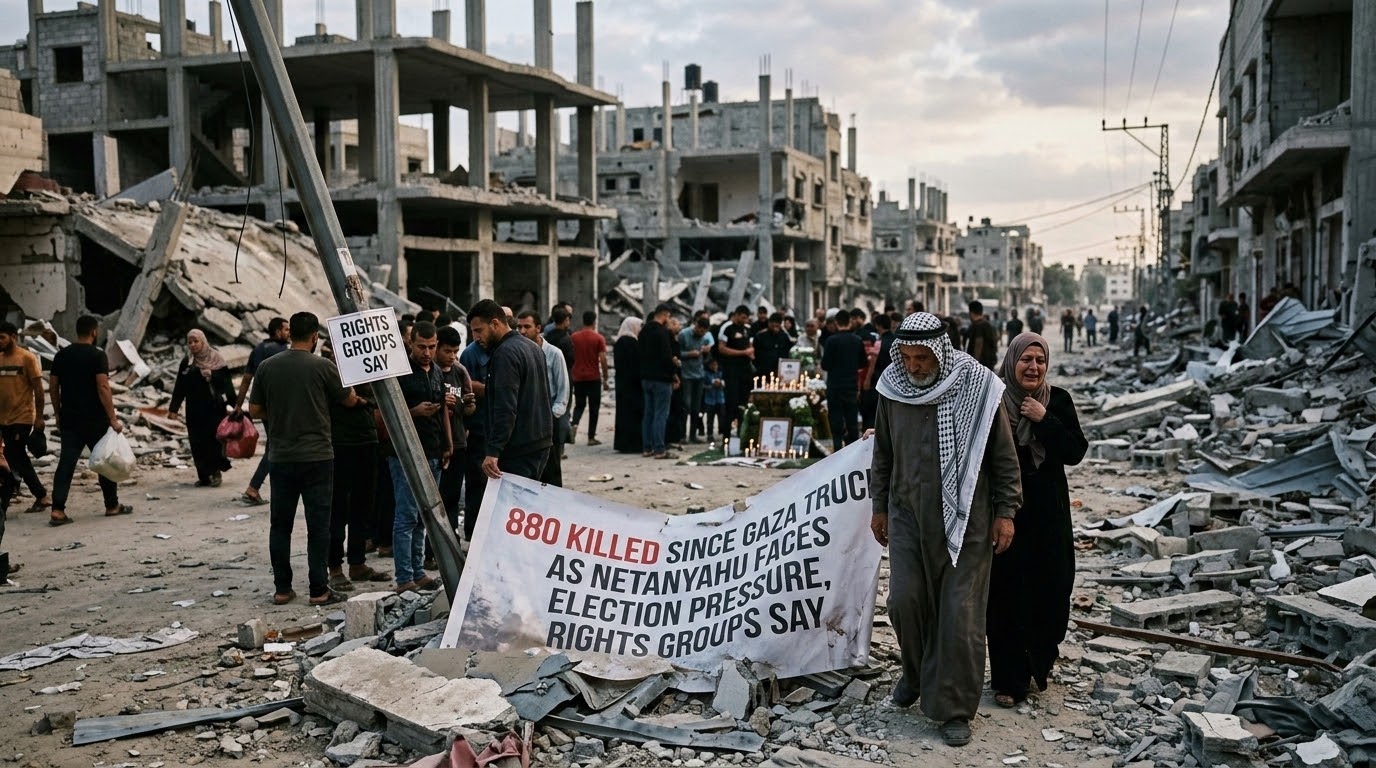
According to Gaza’s health ministry, at least 880 Palestinians have been killed since the ceasefire arrangement took effect, bringing the war death toll to 72,797. The ministry’s figures were cited as rights monitors described a pattern of ongoing strikes, forced evacuations, and demolition of residential areas despite the formal pause framework.
Mai El-Sheikh, spokesperson for the UN Human Rights Office in Palestine, said the truce has been repurposed as political and military cover for continued violations. She said severe limits on food and medicine are worsening panic among displaced families and helping drive what she described as a deliberately manufactured humanitarian emergency.
The Gaza Rights Center reported at least 12 incidents in May in which Israeli forces allegedly called residents and ordered them to evacuate before destroying housing blocks in Nuseirat, Bureij, and Maghazi in central Gaza. The group also documented large-scale land razing east of Deir el-Balah in zones still under Israeli control. The organization said these actions did not reflect a clear military necessity and instead appeared designed to render additional parts of Gaza unlivable.
Impact & Consequences
The immediate effect has been further contraction of habitable space for Gaza’s 2.3 million people. Rights groups say nearly 90 percent of Gaza’s buildings have already been damaged or destroyed during the war, and that warning calls, while sometimes allowing civilians to flee, do not remove obligations under international law to protect civilian life and property.
Analysts warn that the fragile ceasefire architecture is now at risk of full collapse, a scenario many Gazans fear could trigger a broader Israeli ground and air escalation. The continued destruction has also delayed any meaningful recovery, blocked stable aid corridors, and complicated plans for local civilian administration. Regionally, the deteriorating truce has intensified diplomatic strain, as mediators struggle to sustain a framework that exists on paper but appears increasingly unenforced on the ground.
Background & Context
The ceasefire was brokered to halt large-scale hostilities, but implementation has remained weak and contested. With Israel expected to hold national elections in September, several analysts argue Prime Minister Benjamin Netanyahu is prolonging military pressure to satisfy right-wing coalition partners and nationalist voters, while avoiding concessions that could fracture his government.
Mohannad Mustafa, an academic focused on Israeli politics, said Netanyahu is navigating a severe strategic and domestic crisis after failing to achieve his stated Gaza objective of eliminating Hamas. Mustafa said the prime minister is also under pressure over other fronts, including daily hostilities with Hezbollah in southern Lebanon and unresolved tensions with Iran. Eyad al-Qarra, a political analyst in Khan Younis, said Israeli officials have used demands for disarmament of Palestinian factions as a rationale to avoid core ceasefire commitments, adding that even total disarmament would likely not end military operations.
International Response
The international mechanism created to supervise implementation has also weakened. The US-led Board of Peace, formed to oversee Gaza’s administration and truce compliance, has struggled to enforce terms because of member-state divisions and lack of a unified policy line.
Kenneth Katzman, a US-based researcher, said Washington’s focus on Iran has created a diplomatic vacuum that Israel is using to expand operational freedom in Gaza. Nickolay Mladenov, the former Bulgarian foreign minister serving as a Gaza executive member on the Board of Peace, warned the UN Security Council that without a practical reconstruction framework, Gaza will remain vulnerable to prolonged instability and repeated crises.
What to Expect Next
Attention is now turning to whether mediators can salvage a functional ceasefire before election-season politics in Israel harden positions further. Key tests include restoration of aid flows, agreement on reconstruction governance, and credible monitoring of military activity. Without movement on those fronts, diplomats and aid officials warn that Gaza could slide from a broken truce into a renewed, wider offensive with even fewer restraints.