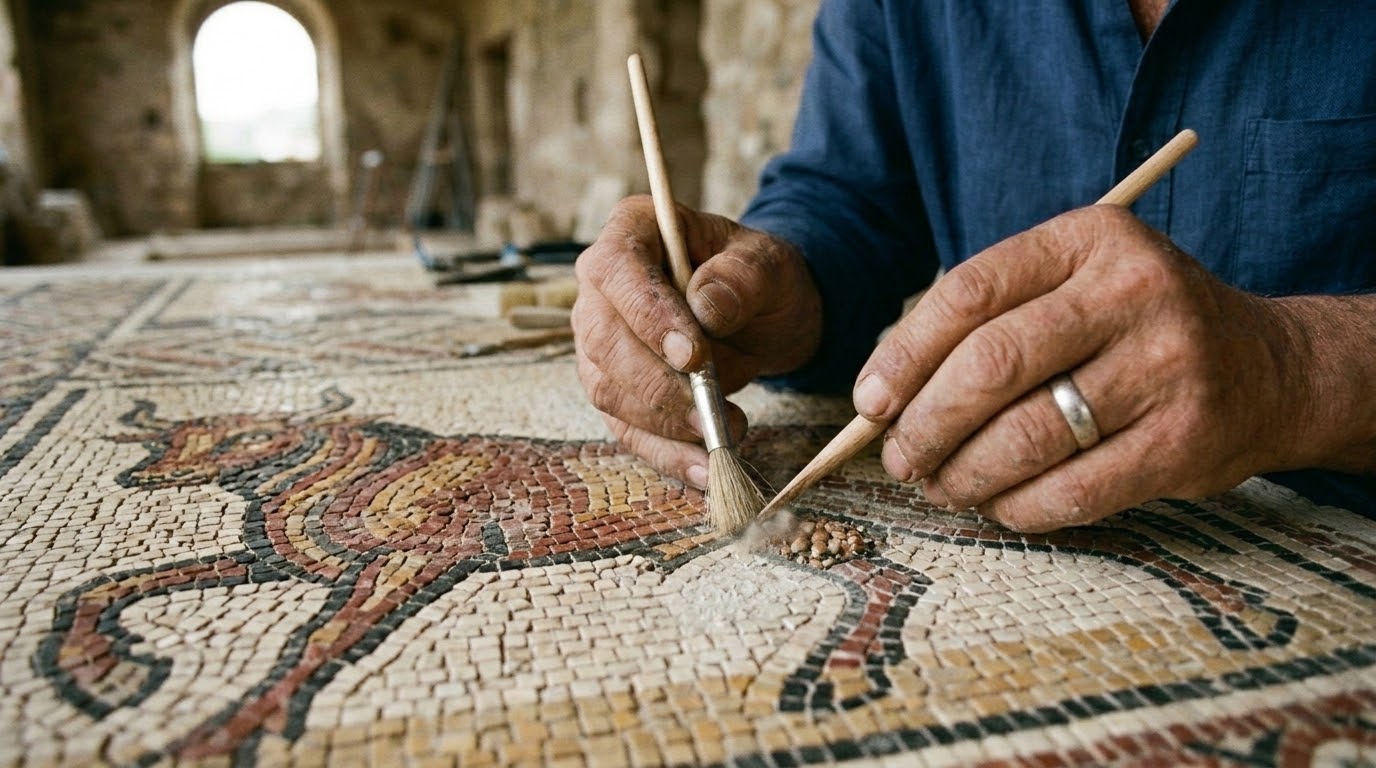
Milan authorities this week launched a new restoration of the famed bull mosaic inside the 19th-century Galleria Vittorio Emanuele II, after years of tourists performing a heel-spinning ritual wore down the artwork’s center. The intervention matters because it highlights the growing pressure mass tourism places on historic public monuments still in daily use.
What Happened
The damaged mosaic lies on the floor of one of Milan’s most visited landmarks, where locals and visitors have long followed a superstition: placing a heel on the bull’s testicles and turning three times, usually clockwise, to attract luck and ensure a future return to the city. According to city officials, the repeated movement by thousands of people each day has gradually abraded the pink stone tiles in that specific area, leaving a noticeable depression.
Milan’s city council said restoration work began this week, with a temporary work zone set up around the artwork. The mosaic depicts a prancing bull against beige and blue tones, encircled by heraldic imagery tied to Turin, Italy’s first national capital. Officials Emmanuel Conte and Marco Granelli said this is the first major intervention since 2017, underlining how quickly high footfall can undo previous repairs in heavily trafficked heritage sites.
Craftsman Gianluca Galli was observed kneeling at the site, shaping replacement stone pieces by hand as passersby watched from the arcade. Speaking to AFP, he described the spinning custom as visually charming but harmful to conservation. His comments reflected a broader challenge faced by restorers: preserving not only the physical integrity of an artwork, but also the social habits that keep it central to urban life.
Impact & Consequences
The new intervention has immediate practical implications for both visitors and city managers. Temporary barriers alter pedestrian flow inside the Galleria, an important commercial and cultural corridor in central Milan. For conservation teams, the work underscores the costs of recurring maintenance on open-access art that cannot be shielded like museum pieces. Repeated replacement of small stone sections is labor-intensive and requires specialist craftsmanship to match original materials and visual continuity.
At a broader level, the case illustrates a policy dilemma shared by many historic cities: whether to restrict visitor behavior at iconic spots or accept cyclical damage as part of living heritage. Milan officials have framed the Galleria as a monument loved through use rather than distance, suggesting continued access over strict prohibition. But every restoration also renews debate over crowd management, preventive signage, and potential protective measures that do not erase local traditions or diminish visitor experience.
Background & Context
The Galleria Vittorio Emanuele II, built in the 19th century, is among Italy’s most recognizable urban arcades and links key civic and commercial areas near the Duomo. Its decorative floors include emblems associated with major Italian cities, among them the bull representing Turin. Over decades, the mosaic became the center of a luck-seeking rite that was already popular among Milanese residents in the 1800s before spreading widely through tourism and travel media.
The ritual’s persistence reflects how informal practices can become inseparable from monument identity. Unlike isolated archaeological ruins, the Galleria functions as a bustling public passage where shopping, sightseeing, and local movement overlap. That daily intensity accelerates wear patterns in specific spots, especially where people concentrate movement for photographs or symbolic gestures. The current restoration follows earlier repairs, including one in 2017, confirming that deterioration at the bull’s center is not a one-time event but a repeating conservation issue.
International Response
While no formal diplomatic response has been reported, the restoration has drawn attention from international visitors and heritage observers who follow preservation challenges in high-tourism cities. Cultural conservation specialists often cite such cases as examples of “overuse damage,” where symbolic participation by the public can unintentionally threaten the very artifact that attracts them.
For global audiences, Milan’s decision to restore rather than isolate the mosaic is likely to be seen as a pragmatic middle path, consistent with approaches in other historic destinations balancing preservation and access. Tourists at the site have continued to gather around the work area, indicating sustained interest in both the legend and the craft process. The visibility of artisan-led repair may also help educate visitors about the fragility and maintenance demands of heritage surfaces under constant foot traffic.
What to Expect Next
In the coming weeks, restorers are expected to complete stone replacement and finishing on the worn section before barriers are removed. City officials will likely monitor how quickly the area degrades again once full access resumes. The key unresolved question is whether Milan introduces stronger preventive guidance around the ritual or continues relying on periodic restoration to preserve the mosaic while allowing the tradition to survive.