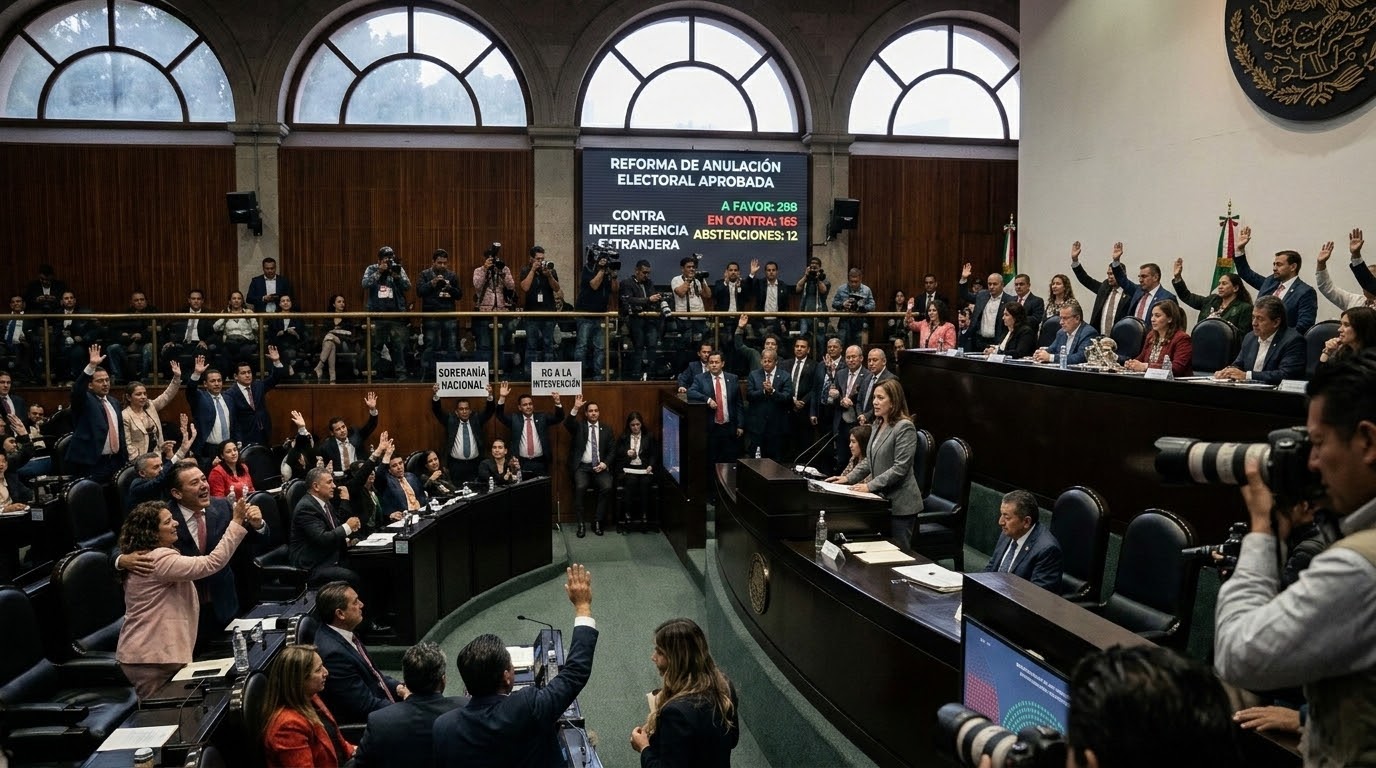
Mexico’s Chamber of Deputies voted Thursday to advance a constitutional change that would allow elections to be invalidated when foreign interference is proven, a move pushed by the ruling Morena party as a defense of sovereignty but criticized by opposition lawmakers as legally vague and politically risky ahead of the 2027 federal cycle.
What Happened
The lower house approved the amendment with 307 votes in favor, 128 against, and one abstention. If ultimately enacted, the reform would expand the constitutional grounds for annulling elections by adding foreign interference to existing causes. The proposal now requires Senate approval before it can take effect nationwide.
The text describes foreign interference as illicit campaign financing, propaganda activity, systematic spread of false information, digital manipulation, and intervention by foreign governments or agencies. It also includes political, economic, diplomatic, or media pressure intended to shape public opinion during an electoral process. Morena leaders argued these categories are necessary to protect Mexico’s democratic system from external influence.
Ricardo Monreal, Morena’s leader in the Chamber, framed the vote as a reinforcement of democratic sovereignty after an extended legislative session. But in a notable step, Monreal also requested the withdrawal of related secondary legislation that would have set technical criteria for proving interference and applying annulment procedures. Morena said implementation deadlines linked to the 2027 election calendar made full rollout impractical in the current period. Under Mexican electoral law, reforms must be approved at least 90 days before the formal start of an election process to be applicable.
Impact & Consequences
The immediate effect is political rather than operational: unless the Senate acts quickly and implementing rules are completed in time, the reform is unlikely to shape the June 2027 federal elections. Even so, the vote signals a tougher institutional stance by the governing bloc toward outside influence, and it is likely to become a central issue in debates over campaign integrity, online information, and media accountability.
Opposition parties argue the constitutional wording is broad enough to create uncertainty for candidates, media organizations, and election authorities. PAN coordinator Jose Elias Lixa rejected claims that opposing the initiative equals support for foreign meddling, saying that argument distorts legitimate legal concerns. PRI lawmaker Ruben Moreira Valdez said his party opposes foreign intervention but questioned enforcement boundaries, warning that unclear distinctions between intervention and broader international “meddling” could invite litigation and post-election disputes. Critics also raised scenarios involving overseas advertising purchases or foreign reporting circulating in Mexico, asking whether such activity could be reclassified as grounds to challenge valid outcomes.
Background & Context
The reform comes amid rising concern within Morena about international pressure on Mexican domestic politics. In recent weeks, party figures have cited criticism from foreign politicians and comments by US President Donald Trump as examples of external narratives that could influence voters. President Claudia Sheinbaum, speaking after the lower-house vote, said there could be a risk of foreign interference in Mexican elections and acknowledged prior cases of foreign funding linked to local candidates and organizations.
Mexico has long debated how to protect electoral sovereignty while preserving open political discourse and press freedom. Previous reforms focused heavily on campaign financing controls and institutional oversight, but the spread of digital messaging and transnational media has complicated traditional enforcement tools. The new amendment attempts to constitutionalize a broader definition of external influence, yet lawmakers have not finalized the secondary legal framework needed to determine standards of proof, investigative powers, and judicial thresholds for nullifying a vote. That gap has become the center of the current controversy.
International Response
No formal external government sanctions or multilateral actions have followed the vote, but the framing of the reform has clear international implications. By citing concerns over foreign officials’ statements and cross-border information pressure, Mexico’s governing party has linked domestic electoral law to regional diplomatic dynamics, especially with the United States. Analysts say that could sharpen scrutiny of foreign political messaging directed at Mexican audiences during campaign periods.
At the same time, legal and democratic governance observers are likely to watch how Mexico defines and enforces “disinformation,” “digital manipulation,” and “media pressure” in secondary statutes. Those terms are increasingly common in election law debates worldwide, but their legal treatment varies widely across democracies. Mexico’s approach could influence broader regional discussions about balancing national sovereignty with free expression and international information flows.
What to Expect Next
The Senate’s review is the next decisive step. If senators approve the constitutional amendment, lawmakers will still need to draft and pass implementing rules that specify evidence standards and adjudication procedures. The main unresolved question is whether Mexico can create a narrowly tailored enforcement model that deters genuine foreign interference without opening a path for politically motivated challenges to election results, especially as parties position themselves for 2027.