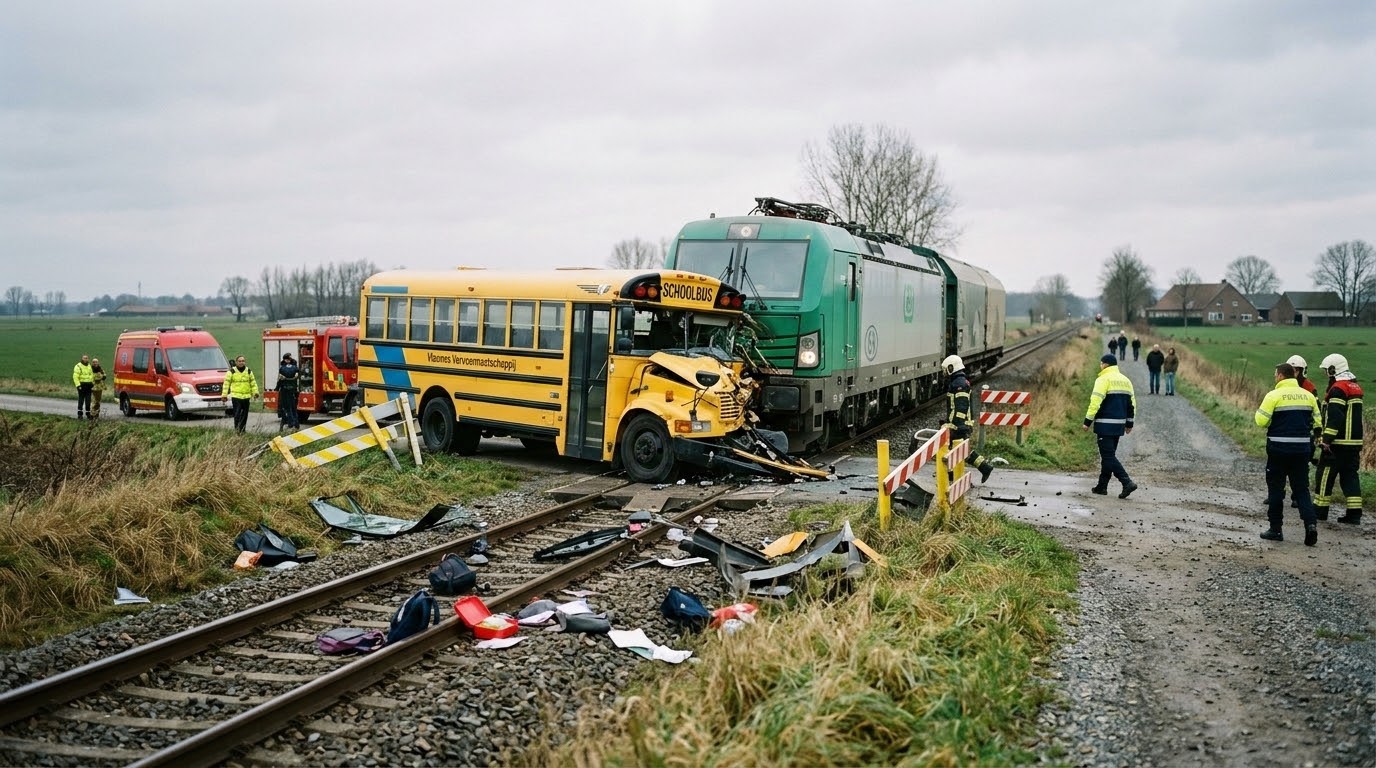
Two children and two adults were killed on Tuesday morning after a train struck a school minibus at a level crossing in Buggenhout, in northern Belgium, in a crash that has shocked the country and prompted a criminal investigation into how a vehicle carrying vulnerable students entered the tracks despite active crossing barriers.
What Happened
The collision occurred shortly after 08:00 local time as the minibus was transporting seven boys to a special education school, according to federal police spokeswoman An Berger. The victims were identified as two boys aged 12 and 15, the 49-year-old driver, and a 27-year-old chaperone. Prosecutors later confirmed that the two boys who died were from Bornem, a town about 12 kilometers north of Buggenhout.
Investigators said the minibus had been traveling along a road parallel to the rail line before turning left toward the crossing. Berger said the crossing barriers were already lowered when the vehicle moved onto the tracks. Mobility Minister Jean-Luc Crucke publicly confirmed reports that the barrier was down at the time. Infrabel spokesman Thomas Baeken told broadcaster VRT that preliminary CCTV review indicated red warning lights were active and the barrier was closed, with some media reports saying the minibus appears to have struck the barrier moments before impact.
The train, traveling at around 90 km/h and slowing on approach to Buggenhout station, hit the bus with what officials described as extreme force. The minibus then struck a pole and was thrown into the driveway of a nearby house. No passengers on the train were physically injured, though one person was treated for shock. The train remained at the crossing for hours while police and prosecutors documented the scene.
Impact & Consequences
The immediate human toll is severe: four deaths and five surviving children hospitalized in what prosecutors described as critical but stable condition. For families in Buggenhout and Bornem, the crash has turned a routine school commute into a mass-casualty event involving children with special educational needs, intensifying public grief and concern over pupil transport safety.
Authorities have moved quickly to secure forensic and legal evidence. During a late-afternoon press briefing, prosecutors said the train driver passed a breath test. They also said a post-mortem examination was under way on the minibus driver, who had no prior criminal convictions. The findings will shape decisions on legal responsibility, if any, and may influence future policy discussions on level-crossing protections, driver training standards, and special-school transport oversight in Belgium’s Flemish region.
Background & Context
Level crossings remain one of the most sensitive points in European rail safety systems because they rely on strict compliance by road users even when warning infrastructure is functioning. In this case, officials from both government and rail network operator Infrabel said early evidence points to operational signals and barriers, making human decision-making a central line of inquiry for investigators.
The incident has also focused attention on transport arrangements for children requiring specialized schooling, who often travel longer distances in dedicated vehicles. Belgian officials have so far avoided assigning blame while emphasizing procedure. Flemish minister Annick De Ridder said it was too early to discuss responsibility. The caution reflects the legal process now underway, in which technical reconstruction, CCTV analysis, witness statements, and medical examinations are expected to determine a definitive sequence of events.
International Response
Messages of condolence came rapidly from Belgian and European leaders, underscoring the wider resonance of the tragedy. Flemish Education Minister Zuhal Demir said her thoughts were with victims, relatives, and everyone directly affected. European Commission President Ursula von der Leyen posted that Europe was grieving alongside Belgium, framing the crash as a shared continental moment of mourning.
At home, King Philippe thanked emergency responders and offered support to all those impacted by what he described as a dramatic event. Buggenhout Mayor Geert Hermans closed a press conference by asking for a minute of silence for the dead. Those symbolic gestures, while not part of the judicial process, have become central to community response as schools, families, and local officials confront the aftermath.
What to Expect Next
Investigators are expected to continue forensic analysis of the crossing, train data, and surveillance footage while awaiting medical and post-mortem findings relevant to the driver’s condition. Prosecutors have not yet released further details on the hospitalized children. In the coming days, Belgium will likely see coordinated local mourning events, and transport authorities may face renewed calls to review level-crossing risk controls and school-route safety protocols.