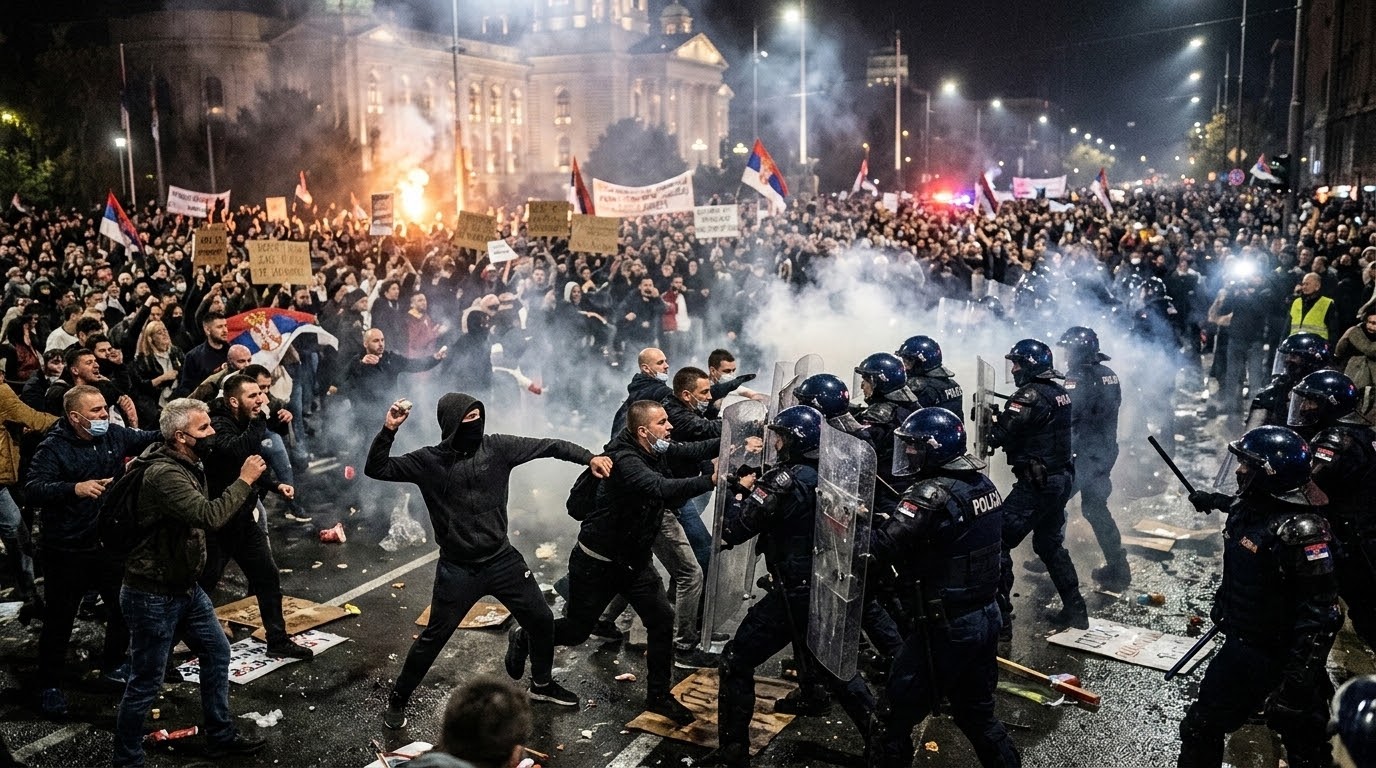
Clashes erupted in central Belgrade on Saturday after a major anti-government rally, as Serbian students and other demonstrators confronted riot police in a renewed challenge to President Aleksandar Vucic’s administration. The unrest signals that a protest movement born after a deadly 2024 station collapse remains potent and politically consequential.
What Happened
Large crowds gathered in the Serbian capital, with many participants carrying banners and wearing shirts marked with the slogan “Students win,” the message adopted by the youth-led movement behind the rally. Protesters called for early parliamentary elections and stronger rule-of-law protections, accusing state authorities of entrenched corruption and criminal conduct.
Tensions escalated near a park encampment of Vucic supporters outside the presidency building. The site, created before another major protest in March, has functioned as a protective buffer between loyalists and anti-government demonstrators. On Saturday, rows of riot police in full protective equipment guarded a fenced-off area where loud folk music played, and confrontations were first reported in that zone.
Authorities also appeared to impose logistical barriers ahead of the rally. Serbia’s state rail operator canceled train services to and from Belgrade, a move widely interpreted as an attempt to reduce turnout from other regions. In a video posted on Instagram while traveling to China on a state visit, Vucic said protesters had displayed a violent character and intolerance toward political rivals, adding that state institutions would continue operating under the law.
Impact & Consequences
The latest violence highlights a deepening domestic standoff between a mobilized protest movement and a government accused by opponents of using coercive tactics to maintain control. For citizens, the immediate effect is heightened insecurity around public demonstrations and concern over whether dissent can be expressed without forceful police intervention. For Serbia’s political system, the clashes raise the stakes around election timing and credibility, especially as student groups say they plan to challenge the ruling bloc this year.
The confrontation also carries broader governance implications. Anti-corruption demands are now directly linked to questions about institutional independence, policing standards, and electoral fairness. If protests continue at scale, authorities may face stronger pressure to permit open political competition. If crackdowns intensify, Serbia risks further reputational damage at a moment when its leadership is trying to balance ties with global powers while preserving access to European integration benefits.
Background & Context
The current protest wave began after the November 2024 canopy collapse at a railway station in northern Serbia that killed 16 people. Many Serbians linked the disaster to alleged corruption and negligence in renovation projects involving Chinese companies, turning public grief into a sustained anti-corruption movement. Demonstrators have since framed the tragedy as evidence of systemic failures in state oversight and accountability.
Political fallout emerged quickly. Under mounting pressure, then-Prime Minister Milos Vucevic resigned in January 2025, but protesters argued the change did not address core demands. As demonstrations persisted, rights groups and critics accused authorities of escalating repression through arbitrary detentions and disproportionate force. Against that backdrop, Saturday’s turnout suggested that government efforts to contain the movement have not ended public mobilization more than a year after the initial trigger event.
International Response
Serbia’s handling of protests has drawn increasing international attention, particularly from European institutions monitoring democratic standards in candidate countries. Following a visit last week, Council of Europe Commissioner for Human Rights Michael O’Flaherty said he would continue closely monitoring developments. In his report, he warned that the overall rights environment had worsened since his previous trip in April 2025.
O’Flaherty also cited allegations that police had shielded unidentified, often masked, attackers targeting journalists and protesters, adding to concerns over press freedom and public safety. The scrutiny comes as Serbia seeks European Union membership while maintaining close relationships with Russia and China. Last month, the EU’s enlargement chief warned that democratic decline could put roughly 1.5 billion euros, or about $1.8 billion, in bloc funding at risk.
What to Expect Next
Attention now turns to election timing and whether authorities permit a fair campaign climate. Vucic said this week that parliamentary polls could take place between September and November, a window student organizers are preparing to contest actively. Further demonstrations are likely, and monitoring by European institutions is expected to intensify as concerns over policing, media safety, and democratic standards shape Serbia’s next political phase.