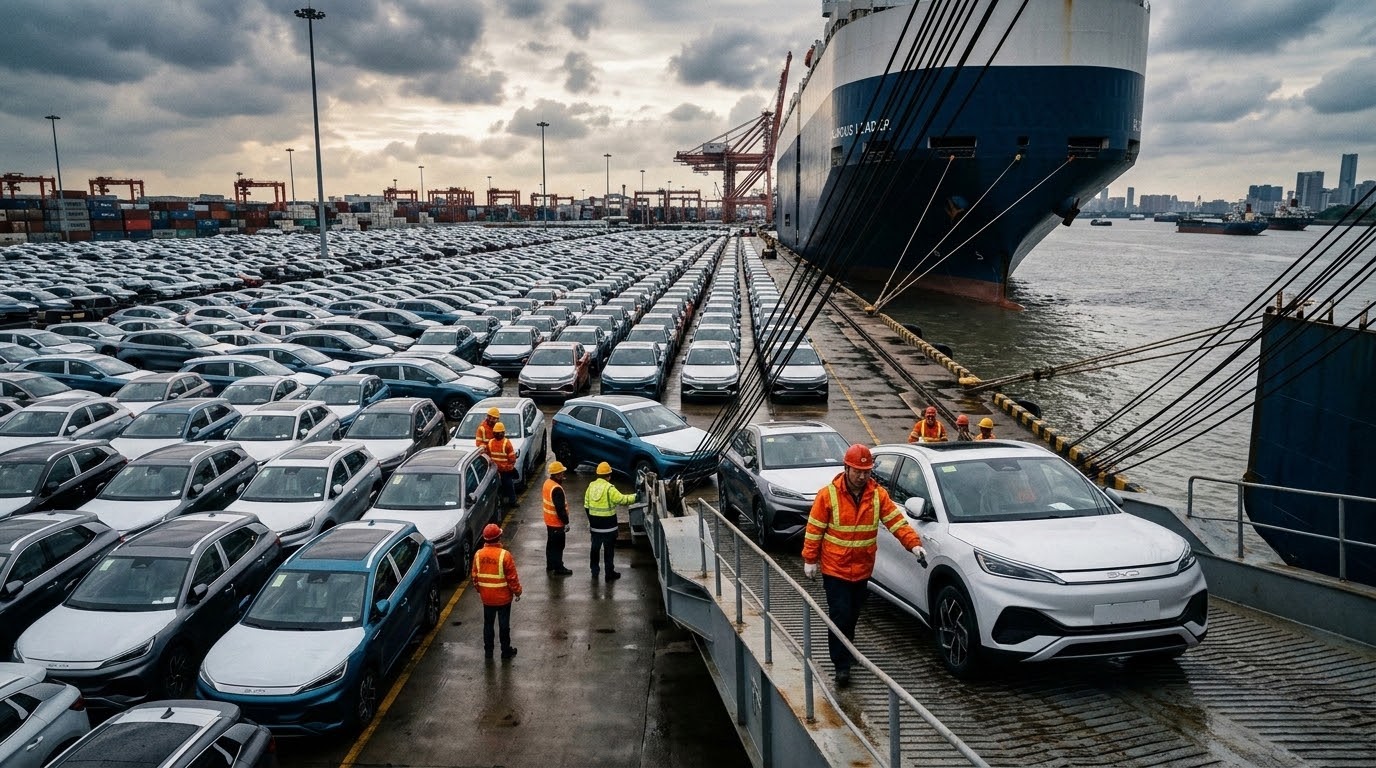
China strengthened its dominance in the global electric-vehicle trade in April, when overseas shipments climbed 40% year on year to 278,081 units, according to customs figures compiled by Bloomberg. The increase matters because it shows demand for Chinese-made EVs is still expanding across multiple regions despite rising tariff and regulatory barriers in major Western markets.
What Happened
The latest customs data indicates China exported 278,081 electric vehicles in April, lifting cumulative shipments for the first four months of the year to 893,852 units. Regional demand was led by Asia, which imported 110,613 vehicles during the month. Europe followed with 83,813 units, while Latin America took in 52,897. Oceania imported 22,695 Chinese EVs, and North America accounted for 4,422.
Among the top destination markets, Brazil posted the sharpest increase in purchases. Imports there rose 221% to 38,144 vehicles, signaling a rapid expansion of Chinese EV presence in South America’s largest economy. South Korea, Germany and Australia also recorded strong growth, with import gains ranging from 100% to 190%, according to the same dataset. The pattern points to a broadening customer base beyond a handful of early-adopter markets.
The April surge comes as Chinese automakers continue scaling exports after a record year. China shipped 2.5 million EVs in 2025, twice the previous year’s level. Industry data from the International Energy Agency says China produced roughly 75% of the world’s 22 million EVs in 2025, cementing its role as the central manufacturing hub for the sector.
Impact & Consequences
The immediate market consequence is a deeper global footprint for Chinese brands in regions with fast-growing EV demand and fewer protectionist barriers. Stronger volumes in Asia and Latin America suggest Chinese producers are increasingly diversifying away from markets where political resistance is highest. For consumers in importing countries, this can expand access to lower-cost EV options and speed fleet electrification, particularly where domestic supply remains limited.
For competitors and policymakers, the numbers intensify pressure over industrial strategy. Established automakers in Europe, Japan and South Korea face a sharper pricing and scale challenge as Chinese manufacturers gain momentum abroad. Governments weighing climate targets and domestic industry protection are also likely to confront harder trade-offs: accelerating affordable EV adoption may conflict with efforts to shield local producers from import competition.
Background & Context
China’s export rise has unfolded in parallel with tougher curbs from the United States and the European Union. Washington applies a 100% tariff on Chinese electric vehicles and has also moved to block certain Chinese-made software used in connected cars. The EU has imposed duties reaching as high as 35.3% on Chinese EV imports, reflecting long-running concerns over market distortion and competitive imbalance.
Yet outside those heavily contested markets, Chinese models have already gained dominant share. The International Energy Agency reported that, excluding Europe and the US, Chinese brands represented 55% of EV sales last year. More broadly, the global transition to electric mobility continues at speed: worldwide EV sales exceeded 20 million in 2025, roughly one-quarter of all vehicle sales, and the IEA projects 23 million sales in 2026, close to 30% of the global auto market.
International Response
Government responses remain divided. The US and EU have prioritized defensive trade measures, arguing for safeguards as domestic industries scale up. Their policies have reshaped market access but have not stopped China’s overall export expansion, which has shifted more heavily toward Asia, Latin America and Oceania. Importing countries in those regions, many focused on affordability and rapid electrification, have generally continued buying in rising volumes.
International energy and industry observers are treating the latest figures as evidence that EV competition is becoming more globally fragmented. Rather than one integrated market, the sector appears to be splitting into high-barrier and lower-barrier zones, with Chinese supply increasingly concentrated in the latter. That dynamic may influence future bilateral trade talks, local manufacturing incentives and rules on technology standards for connected vehicles.
What to Expect Next
In coming months, analysts will watch whether China’s export pace remains near April levels and whether major destinations such as Brazil sustain triple-digit growth rates. Policymakers in the US and Europe are also expected to keep refining tariff and security frameworks. At the same time, rising demand across emerging markets could encourage Chinese automakers to deepen local partnerships, assembly plans and distribution networks to lock in long-term market share.