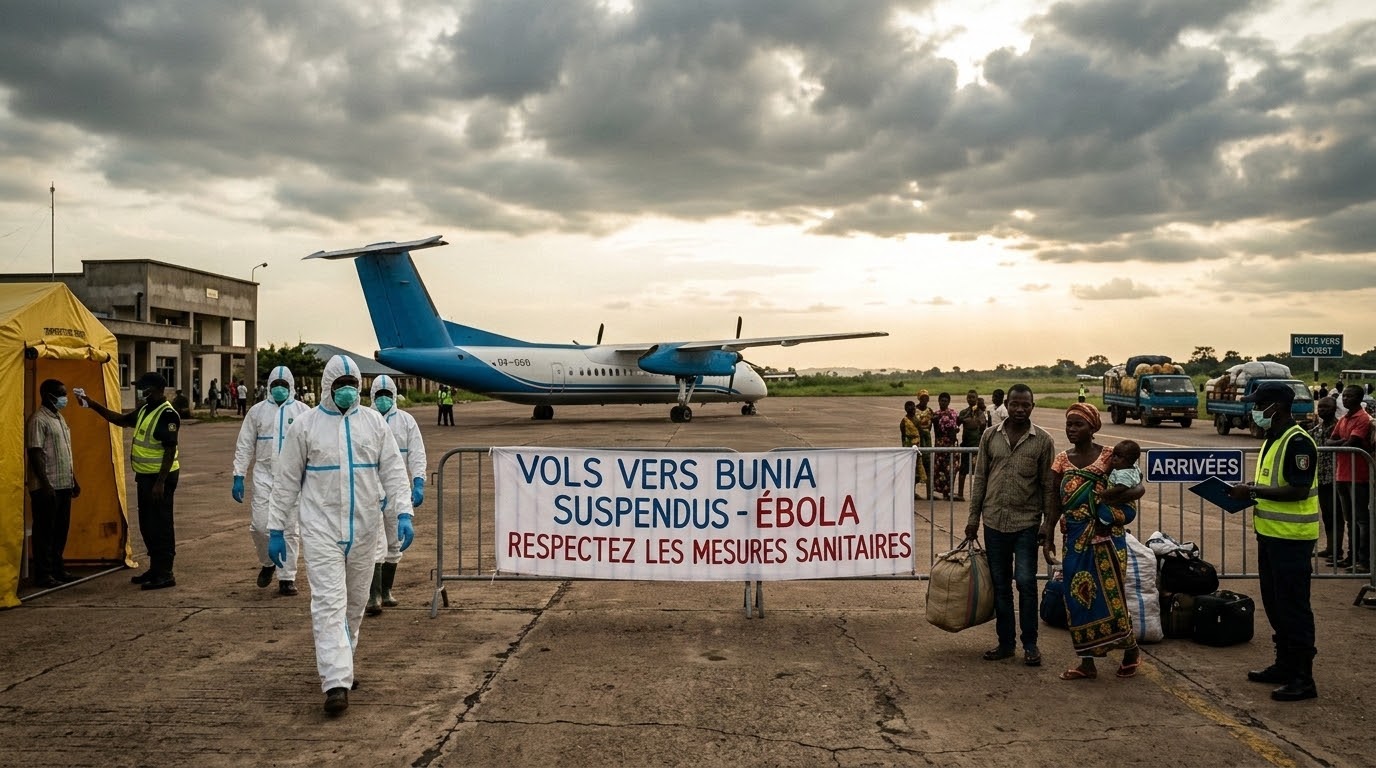
Authorities in the Democratic Republic of the Congo have suspended all air traffic to and from Bunia, capital of Ituri province, as part of emergency measures announced in late May 2026 to contain a growing Ebola outbreak. The decision matters beyond public health, because Bunia is a critical logistics hub for eastern Congo and cross-border commerce with Uganda.
What Happened
The suspension was ordered by the Ministry of Transport and Communications, which instructed airport services in Bunia to enforce health directives issued by national authorities. In a statement, officials said the measure was designed to reduce the risk of cross-border transmission and protect passengers, flight crews, and airport workers while the epidemic continues to spread in eastern DRC.
Kinshasa has carved out limited exemptions. Humanitarian, medical, and emergency operations may still be allowed, but only with special authorization from civil aviation and health officials. The exception is intended to preserve essential movement of doctors, response teams, medical cargo, and aid supplies needed for the Ebola response in affected health zones.
The closure has drawn concern from local residents and businesses. Pascal Tudja, an economic analyst in Bunia, said shuttering the airport would be highly disruptive because roads are in poor condition and many residents rely on flights. Traders and service providers echoed that warning, saying the city’s dependence on air links makes abrupt transport interruptions especially damaging.
Impact & Consequences
The restrictions are already reshaping daily economic life in Bunia. Uganda, a major gateway for goods and passengers moving into Ituri, has also imposed limits on travel to and from the DRC to prevent Ebola spread. Together, the airport shutdown and tightened cross-border movement have slowed trade routes that feed Bunia’s markets, placing pressure on retailers and consumers.
Local business owners describe immediate strain. Clothes merchant Sarah Bitangalo said she could not fulfill customer orders because imports from Kampala were blocked by the border situation. Investor Mitterrand Mweze, who has spent nearly two decades building hotels, bars, and leisure facilities in Bunia, said the airport closure effectively isolates the city from potential clients and investors. He urged authorities to consider tax relief, warning that many enterprises cannot sustain normal obligations while transport access remains restricted. Analysts also caution that prolonged disruption could trigger shortages and price spikes for food and non-food items.
Background & Context
The Bunia health zone is among 11 Congolese health zones affected in an Ebola outbreak declared in mid-May 2026. According to the Congolese Ministry of Public Health, more than 930 cases had been reported by May 26 across North Kivu, South Kivu, and Ituri provinces, with over 220 deaths. Health experts identify the circulating virus as the Bundibugyo strain, one of six Ebola species, with a reported fatality rate that can reach 50 percent.
The outbreak is unfolding in a region where transport and trade infrastructure is already fragile. UN-Habitat estimates that about half of Bunia’s economic activity comes from the tertiary sector, including services, transport, retail, and public administration. That structure makes the local economy particularly sensitive to shocks affecting mobility. For many residents, the immediate challenge is balancing strict disease-control measures with basic market functioning, household income, and access to essential goods.
International Response
Regional governments and international institutions have intensified containment efforts as infections cross high-traffic corridors in eastern Congo and neighboring Uganda. Kampala’s tighter travel controls reflect concern that routine commercial and passenger flows could accelerate transmission along border districts linked to Ituri.
The Africa Centres for Disease Control and Prevention has said that nearly $500 million has been pledged and committed by African governments and international partners to support Ebola operations in the DRC and Uganda, as well as preparedness in other countries considered at elevated risk. Humanitarian and medical flight exemptions from Bunia are expected to remain central to that response, allowing aid delivery and specialist deployment even as broader civil aviation activity is suspended.
What to Expect Next
Officials are likely to review the Bunia flight suspension based on case trends, surveillance data, and treatment capacity in affected zones. The key question is how long strict transport controls can be sustained without deeper economic fallout. Residents and businesses are pressing for accompanying support, including tax adjustments and supply protections, while health authorities focus on preventing wider regional spread.