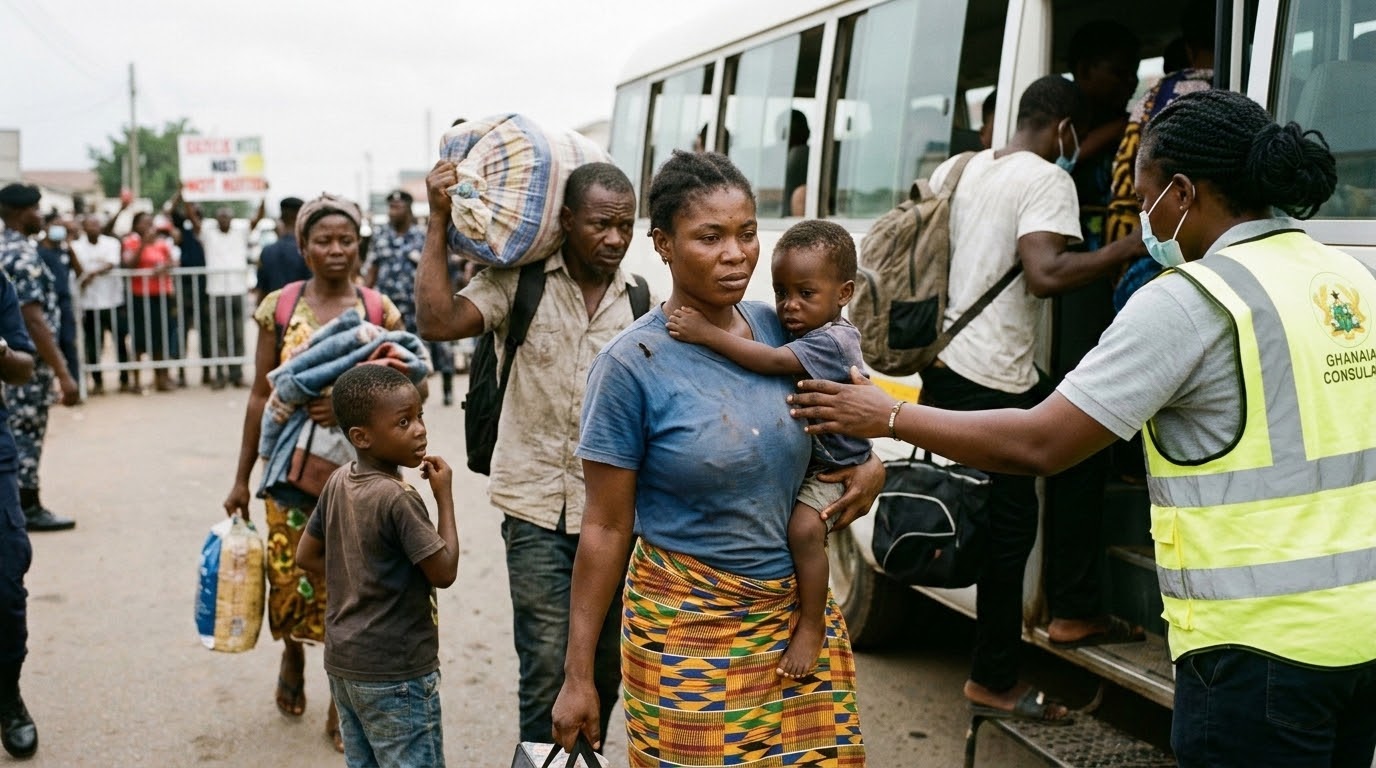
Ghana has evacuated the first group of its nationals from South Africa, flying 297 people out of Johannesburg after weeks of anti-immigration protests raised fears of renewed xenophobic attacks. The operation, carried out this week, marks the start of a wider repatriation effort involving about 800 Ghanaians who requested to return home.
What Happened
The chartered departure took place at OR Tambo International Airport in Johannesburg, where men, women and children arrived before dawn under embassy supervision. Ghana’s High Commissioner to South Africa, Benjamin Quashie, said all passengers were processed by diplomatic and airport teams before boarding. He confirmed that 297 citizens ultimately departed on the flight, the first in what could become a larger series of returns.
According to officials, one mother and her two children were not cleared to leave because she could not produce the children’s birth certificates, underscoring the documentation hurdles that can complicate emergency departures. A separate, smaller group reached the airport in a police vehicle and was kept apart from most travelers while police remained on site. Few passengers gave interviews, but one returnee, identified as Rudolph, said he had lived in South Africa for a decade and operated a salon before deciding conditions had become too unsafe.
Rudolph linked his decision directly to the expanding protest movement, which began in Durban and spread to additional provinces. He said the atmosphere had become increasingly hostile and voiced concern that the campaign’s stated 30 June deadline for undocumented migrants to leave could trigger violent incidents. South Africa is estimated to host around 25,000 Ghanaians, many of whom are now weighing whether to stay, relocate internally, or seek return options.
Impact & Consequences
The evacuation highlights a growing humanitarian and diplomatic challenge for both Accra and Pretoria. For families leaving South Africa, the immediate impact is economic as well as personal: many had small businesses or informal livelihoods that are now disrupted. Quashie said Ghana had acted because citizens reported fearing for their lives, feeling unwelcome, and saying their income-generating activities had stalled amid the unrest.
The departure also carries policy implications. Ghana says it is implementing a reintegration plan for returnees, including support to re-establish businesses at home. Quashie indicated that some returnees may have lacked legal status in South Africa, framing the repatriation as both a protection effort and a signal that Ghana does not endorse undocumented migration. For South Africa, the exodus may reduce immediate pressure points in flashpoint communities, but it also risks reinforcing perceptions that foreign nationals remain vulnerable despite official assurances.
Background & Context
Recent demonstrations have been led by a group calling itself March and March, which describes its campaign as citizen-driven pressure for immigration reform. Protesters argue that undocumented migration is straining jobs and public services and have demanded tougher state action. Organizers say their actions are peaceful, but public anxiety has grown due to South Africa’s history of anti-foreigner violence and inflammatory rhetoric around migration.
Those fears are rooted in past bloodshed. In 2019, at least 12 people were killed in attacks linked to anti-foreigner unrest. In 2008, 62 foreign nationals died in major xenophobic violence across the country. Some analysts now suggest current anti-migrant mobilization may also be shaped by domestic political calculations ahead of local elections expected in November, when immigration issues often become sharper in campaign debates and public discourse.
International Response
South African authorities have publicly condemned criminal acts targeting foreign nationals while also acknowledging pressure to address irregular migration. The balancing act has drawn scrutiny as anxiety rises among migrant communities. In Durban, more than 300 foreign nationals reportedly camped outside Home Affairs offices after first seeking refuge at a police station, saying they feared imminent attacks and wanted state protection.
A Congolese woman quoted by local media said migrants had been repeatedly warned that foreigners would be killed after 30 June. Such statements, whether verified threats or rumor-driven panic, have accelerated fear among non-South African residents. Ghana’s response has therefore been watched by other African missions in Pretoria as a possible template for consular crisis action: rapid registration, organized departure, and reintegration support in the country of origin.
What to Expect Next
Further Ghanaian evacuations are likely if security concerns persist and more of the roughly 800 registered applicants are cleared to travel. Attention will now focus on whether South African authorities can prevent violence as the 30 June deadline approaches and reassure migrant communities. The effectiveness of Ghana’s reintegration program will also be closely monitored, as returnees seek income, housing stability, and long-term alternatives after leaving livelihoods behind.