Supporters of Crystal Palace and Rayo Vallecano were involved in violent confrontations in central Leipzig on Tuesday night, just before their Conference League final, with German authorities reporting injuries to two police officers and two arrests. The unrest matters beyond one fixture, as Europe faces renewed scrutiny over fan safety at high-profile matches.
What Happened
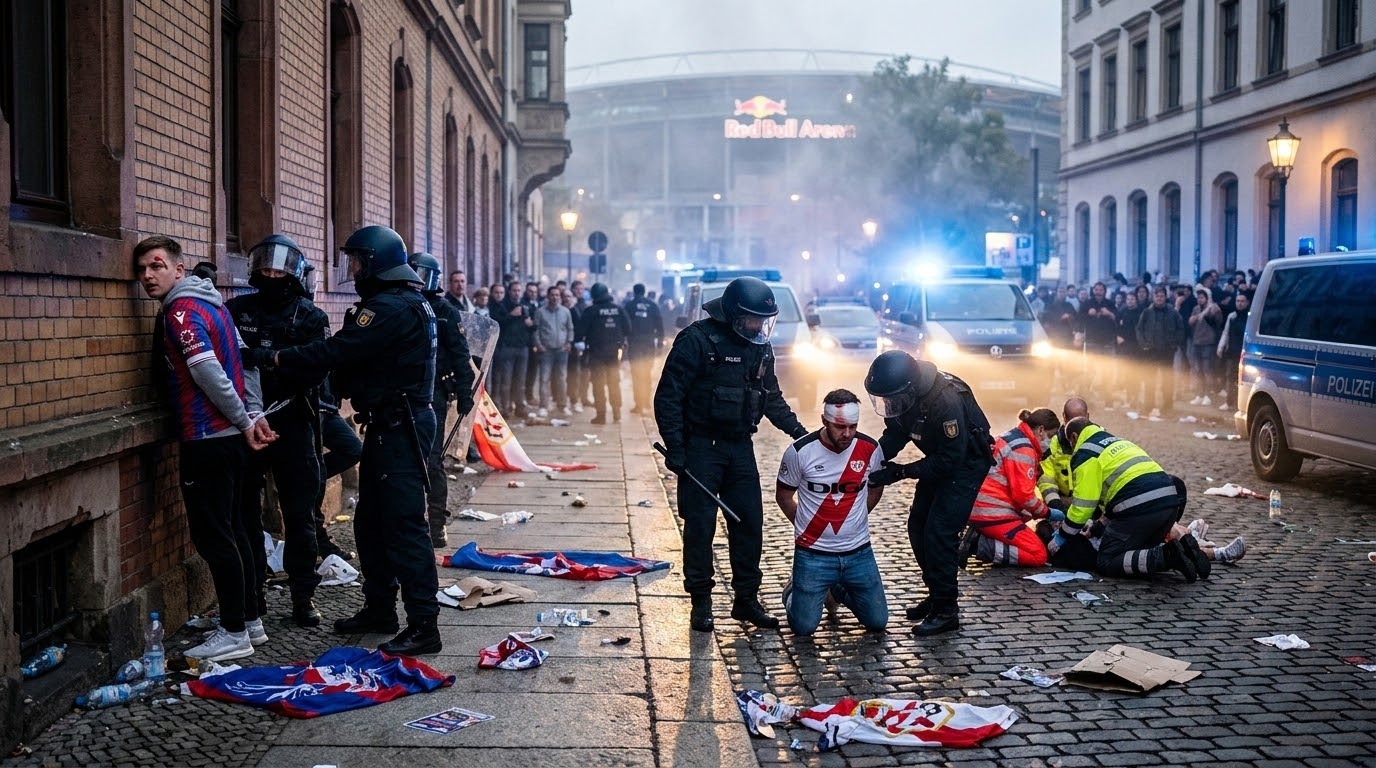
According to Saxon State Police, trouble began at about 20:00 local time when around 300 Rayo Vallecano supporters, described by authorities as posing a high hooliganism risk, gathered in Leipzig’s city center. Police said encounters between Spanish and English supporters quickly turned both verbal and physical, with projectiles thrown during the disorder.
Leipzig police reported that bottles, beer glasses and outdoor restaurant furniture were used during the clashes. Officers said riot police already deployed in the city moved rapidly to separate opposing groups. Even so, police units assigned to both sets of fans were also targeted by thrown objects. Two officers suffered minor injuries but were able to remain on duty, authorities said on Wednesday.
Police also detailed a separate confrontation near the Penguin Ice Bar involving fans linked to Crystal Palace. In that episode, about 60 Palace supporters described as known troublemakers allegedly provoked passing Rayo fans before federal police intervened and surrounded the group. Across both incidents, officers checked the identities of more than 300 people, and police confirmed two arrests in total.
Impact & Consequences
The violence has increased pressure on local and tournament security planners, who now face the challenge of containing risk among large, emotionally charged traveling fan groups ahead of a first-ever European final for both clubs. For residents and businesses in central Leipzig, the incidents also underscore how quickly celebratory atmospheres around major sporting events can spill into public disorder, especially in busy hospitality districts.
For football authorities and national policing agencies, the episode is another warning that international club finals can carry security demands similar to those seen at domestic derbies with known hooligan elements. The immediate consequences include tighter crowd management, heavier police visibility and closer monitoring of identified risk supporters. Organizers will also be mindful that any further disturbance could overshadow the sporting significance of the final and damage the broader image of European competition hosting.
Background & Context
Wednesday’s final is a landmark occasion for both teams, with Crystal Palace and Rayo Vallecano each appearing in their first European final. The match is also the final game in charge for Palace coach Oliver Glasner, who is set to depart at the end of the season. That combination of historical stakes and emotional intensity has contributed to exceptionally high fan turnout and a charged pre-match environment in Leipzig.
The final also sits within a wider week of major European club fixtures. Aston Villa secured the Europa League title last week, while Arsenal are due to face Paris Saint-Germain in the Champions League final on Saturday in Budapest. Security concerns were already elevated after violence and rioting in Paris following PSG’s semifinal victory at Bayern Munich, prompting expectations of robust policing in Hungary as authorities attempt to prevent a repeat of unrest around marquee matches.
International Response
German police statements emphasized rapid intervention and coordination between Leipzig officers, riot police and federal forces, reflecting a broader cross-agency approach now common at major continental events. While no formal political statements were issued in the immediate aftermath, the messaging from law enforcement focused on deterrence, identity checks and early separation of rival fan groups to prevent escalation before kickoff.
Across European football circles, the incidents are likely to reinforce ongoing cooperation between host cities, domestic leagues and continental organizers on supporter movement, risk profiling and matchday operations. With another high-risk final looming in Budapest, security planning in multiple countries will be closely watched by clubs, local governments and transport authorities, all keen to avoid a cycle in which fan violence becomes a defining part of tournament narratives.
What to Expect Next
Authorities are expected to maintain an intensified security posture through matchday, including crowd segregation, visible patrols and continued checks on known risk supporters. Further updates may include details on charges linked to the two arrests and any additional disciplinary steps. Attention will then shift quickly to Budapest, where policing plans for Arsenal versus PSG are likely to be tested under similarly heightened concern.