California Governor Gavin Newsom declared a state of emergency in Orange County after emergency crews warned that a tank holding roughly 7,000 gallons of volatile methyl methacrylate could fail at a Garden Grove aerospace facility, raising the risk of a major toxic release or blast and forcing thousands of residents to evacuate.
What Happened
The emergency centers on a damaged storage tank at a plant operated by GKN Aerospace, a UK-headquartered supplier of aircraft components located about 35 miles southeast of Los Angeles. Fire officials said the vessel contains methyl methacrylate, a flammable chemical used in plastics manufacturing, and that internal reactions were driving temperatures upward. By Saturday, Orange County Fire Authority division chief Craig Covey said the tank had reached about 32C (90F) and was rising at roughly one degree Fahrenheit per hour.
Authorities had initially believed cooling efforts were working. On Friday evening, drone heat readings suggested the tank had dropped to around 16C (61F). But once responders moved closer and checked the gauge, they found the inside temperature was substantially higher than expected. Covey said teams were working to slow the chemical reaction and pressure buildup while preparing for two potential outcomes: rupture with spill, or thermal runaway leading to explosion.
Evacuation orders were issued for a one-mile zone around the site in Garden Grove, with local schools closed and exits on several major roads shut to limit access. Disneyland, about five miles away, remains outside the evacuation perimeter and has continued normal operations. Health officials urged residents to report any “fruity and heavy” odor, a possible sign of vapor release, even if symptoms are not yet present.
Impact & Consequences
The immediate public safety impact has been significant. Thousands of residents were displaced, some sent to temporary shelter at the Garden Grove Sports and Recreation Center. Officials warned that inhalation of vapors may cause eye irritation, breathing problems, and dizziness, while also stressing that people beyond the one-mile evacuation boundary should remain safe under current conditions. For nearby communities, uncertainty over when the threat will end has become a major concern.
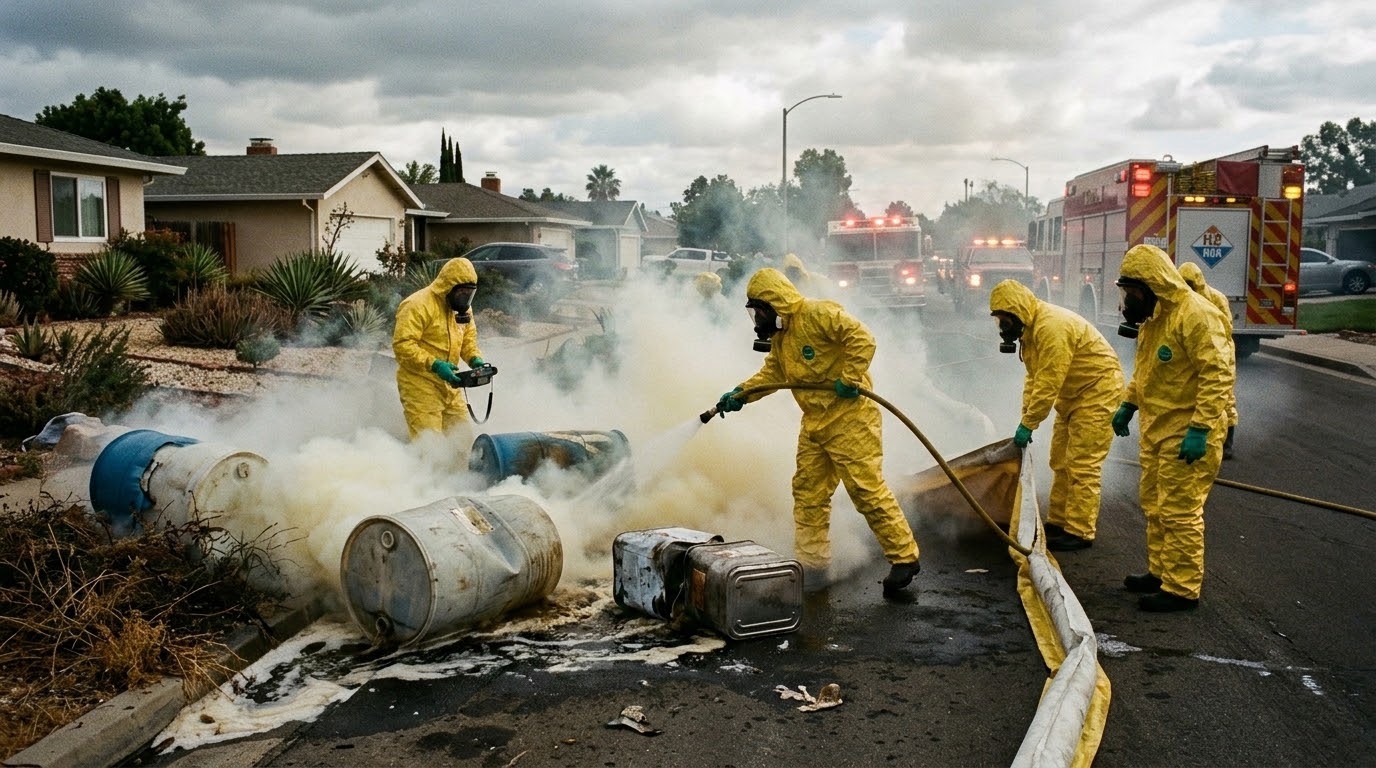
The environmental and infrastructure risks are also central to response planning. Fire crews said they are building containment barriers, including dykes and dams, to prevent any leaked chemicals from entering storm drains and eventually the ocean if the tank ruptures. A wider explosion scenario could endanger neighboring tanks containing fuel or other chemicals, potentially escalating into a more complex industrial disaster with prolonged road closures, business disruption, and a larger hazardous materials operation.
Background & Context
Methyl methacrylate is widely used in the production of acrylic plastics and other industrial materials, but it requires strict temperature and pressure controls because of its flammability and volatility. Emergency officials said an inoperable valve at the facility added complications to efforts to stabilize the vessel, and the cause of the tank’s deterioration remains under investigation. Covey said responders regarded passive monitoring as unacceptable and were pursuing aggressive intervention plans.
The incident has underscored longstanding concerns around high-hazard industrial operations in densely populated parts of Southern California. Garden Grove sits in a heavily interconnected urban region where schools, arterial roads, and commercial sites lie close to manufacturing zones. Officials repeatedly emphasized that this was not a routine precaution, with Covey warning that failure was expected, though timing and mode remained uncertain. That uncertainty has shaped all operational decisions, from evacuations to containment engineering.
International Response
Because the site is run by GKN Aerospace, an international supplier with UK roots, the event has drawn attention beyond California from aviation and manufacturing stakeholders monitoring continuity and safety performance. In a public statement, a company spokesperson apologized to affected residents and said GKN was focused on coordinating with emergency services, specialized hazardous materials teams, and relevant authorities to protect the community and workers.
No foreign government intervention has been announced, but the case is likely to be watched by regulators and industry safety experts globally as an example of emergency management at a critical aerospace supplier facility. Public health messaging from Orange County officials, including guidance on odor detection and symptom awareness, has become part of the broader response model likely to be examined by industrial risk professionals internationally.
What to Expect Next
Authorities are expected to continue round-the-clock cooling and pressure-control operations while refining plans for either controlled spill management or blast response if thermal runaway occurs. Evacuation orders, school closures, and traffic restrictions are likely to stay in place until temperature trends stabilize. Investigators will examine mechanical failures, including the reported valve problem, as officials decide when residents can safely return and whether longer-term environmental monitoring is required.