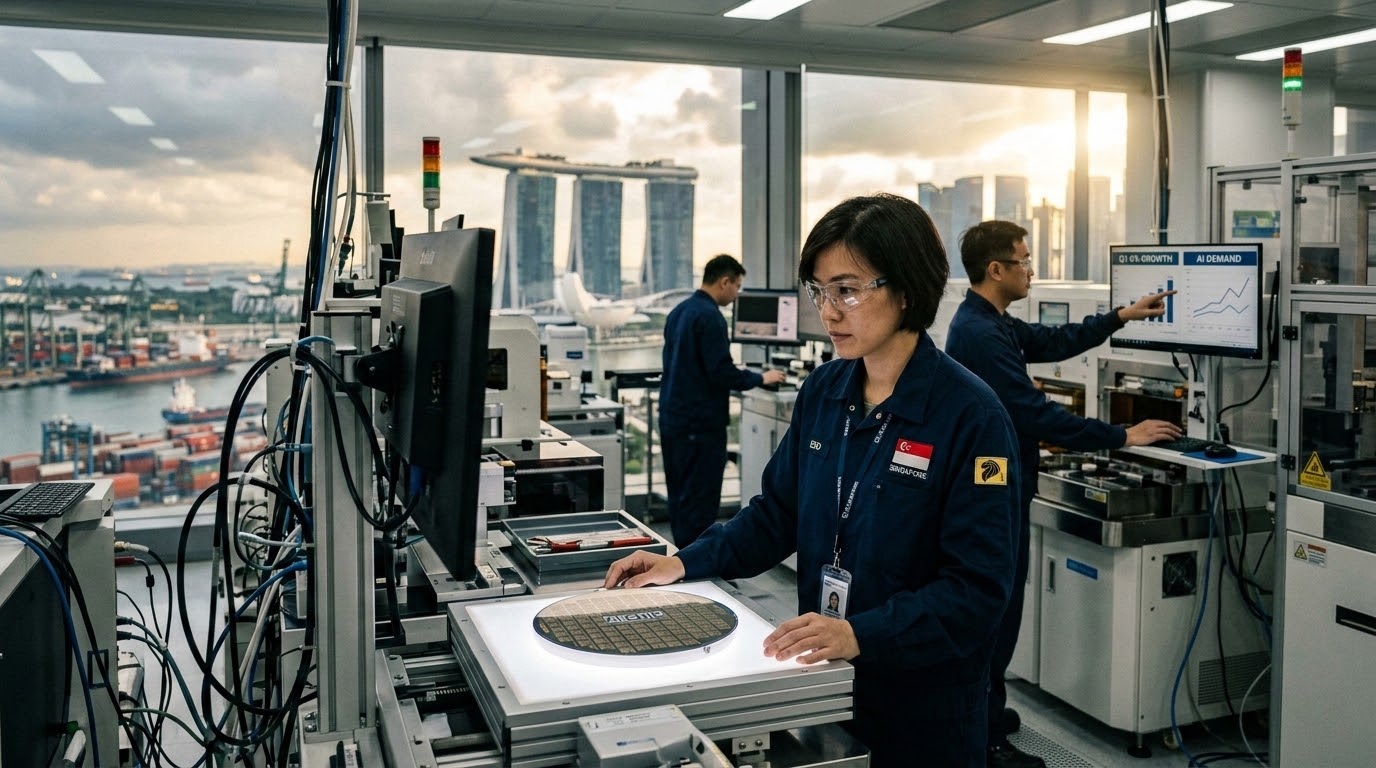
Singapore reported a stronger-than-expected economic expansion in the first quarter of 2026, with output rising 6 percent from a year earlier, as demand tied to artificial intelligence hardware lifted key industries despite worsening disruption to global shipping routes linked to the US-Israel war on Iran.
What Happened
In figures released Monday, Singapore’s Ministry of Trade and Industry said gross domestic product grew 6 percent year-on-year in the January-to-March period, above the official advance estimate of 4.6 percent. Compared with the previous quarter on a seasonally adjusted basis, the economy expanded by 1 percent. The ministry said growth was led by wholesale trade, manufacturing, and finance and insurance.
Officials pointed specifically to AI-driven momentum in business segments linked to machinery and equipment distribution, as well as electronics and precision engineering output. Singapore, a major node in global semiconductor supply chains, has benefited from continued investment in AI infrastructure that requires advanced chips and manufacturing equipment. The ministry said this demand remained resilient even as global uncertainty intensified.
At the same time, the government left its full-year 2026 growth projection unchanged at 2 to 4 percent. It cited downside risks from higher energy and fertilizer costs caused by heavy shipping disruption through the Strait of Hormuz, where competing blockades by Iran and the United States have constrained maritime traffic. Authorities said those pressures are expected to weigh on global activity through the remainder of the year.
Impact & Consequences
The data signals that Singapore’s external-facing economy still has strong engines of expansion, but also highlights how concentrated that strength is. The AI investment cycle has become a major support for industrial production and trade-related services, helping offset weaker sentiment tied to conflict-driven supply shocks. For policymakers, the result offers near-term reassurance while reinforcing caution over conditions beyond domestic control.
For businesses and households, the implications are mixed. Strong headline growth supports employment and corporate earnings in high-tech and finance-linked sectors, yet price pressures from energy and imported inputs could still spread across the broader economy. Economists have warned that first-quarter figures may not fully capture the fallout from Middle East disruptions, suggesting second-quarter data could present a clearer picture of stress on costs, shipping reliability, and downstream demand.
Background & Context
Singapore is among the world’s most trade-dependent economies and is deeply integrated into global manufacturing and logistics networks. That structure has made it highly responsive to both external shocks and technology upcycles. In the current cycle, the country has played a significant role in the AI hardware rollout as a producer of semiconductors and chipmaking equipment, accounting for roughly 10 percent of global semiconductor output and about 20 percent of semiconductor equipment production.
The present growth story is unfolding against a fragile international backdrop. Nearly three months after the start of the US-Israel war on Iran, shipping flows through the Strait of Hormuz remain severely affected, raising freight and input costs worldwide. Last week, the United Nations lowered its 2026 global growth forecast to 2.5 percent from 2.7 percent, citing economic damage linked to the conflict and related market disruptions.
International Response
Regional and market analysts have interpreted Singapore’s performance as unexpectedly robust, while warning that the strongest effects of the geopolitical shock may still be ahead. Khoon Goh, head of Asia research at ANZ, said the first-quarter numbers likely understate the full impact of the Middle East crisis and suggested consequences could become more visible in the second quarter. He added that the solid first quarter nonetheless creates a stronger starting point for the rest of the year.
Academic economists in Singapore offered similarly cautious assessments. Anthony Tay of Singapore Management University said the latest data would likely be received with relief rather than celebration, noting that forecasters now broadly expect around 3.6 percent growth for 2026 but still recognize substantial downside risk. Yeow Hwee Chua of Nanyang Technological University said the key test is whether sector-led strength can broaden into wider domestic confidence.
What to Expect Next
Attention will now shift to second-quarter indicators, especially export orders, shipping costs, and inflation-sensitive sectors, to determine whether AI-linked momentum can continue to shield the economy. The central question is whether growth broadens beyond high-tech and trade channels into household demand. If Hormuz disruptions deepen, policymakers may face harder trade-offs between preserving competitiveness, managing imported inflation, and sustaining confidence.