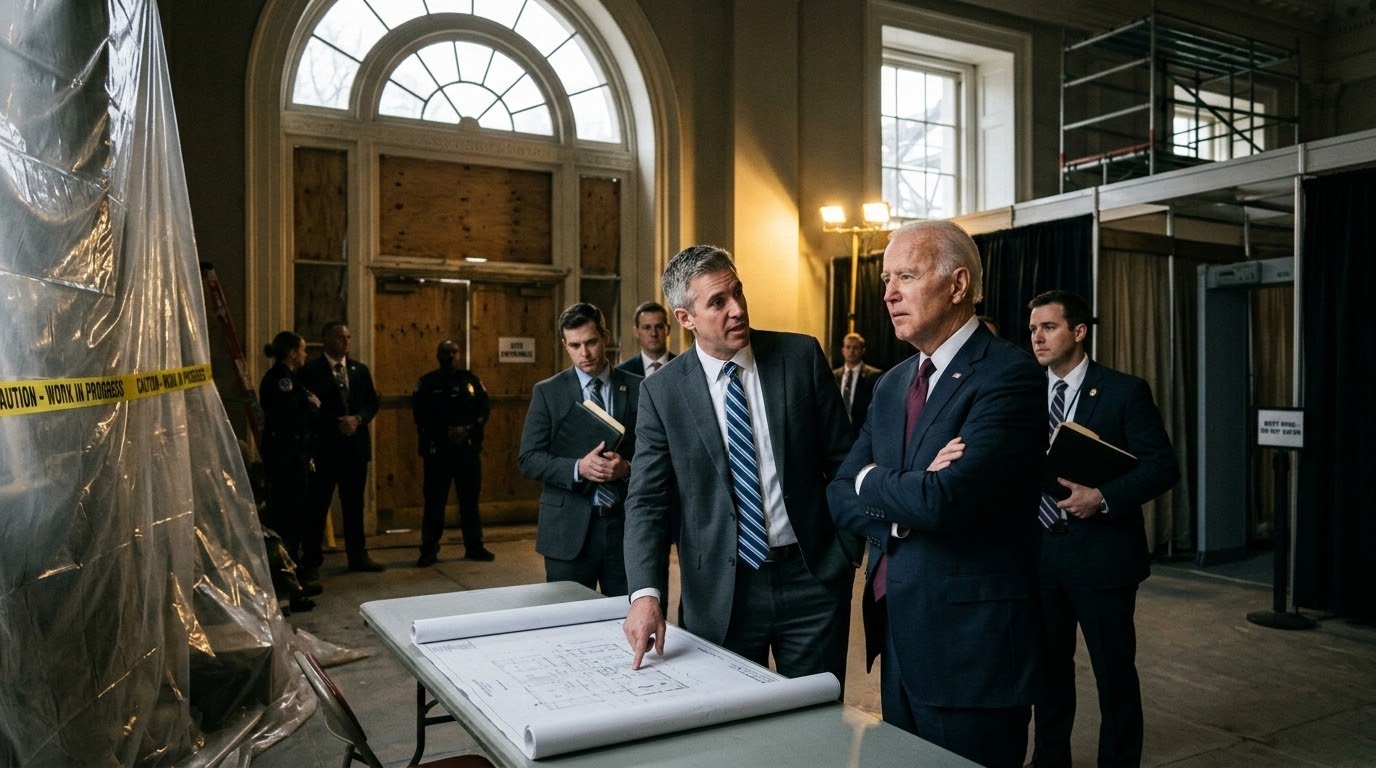
The Trump administration has renewed its request to resume work on a planned White House ballroom, telling a federal court in Washington that recent gun violence near presidential events makes the project urgent. The filing, submitted Sunday by acting Attorney General Todd Blanche, seeks to overturn a temporary judicial block that has stalled construction since late March.
What Happened
In a new court submission, Blanche argued the lawsuit pausing the ballroom is harming US interests and delaying what he described as a critical security project. He cited a shooting last Saturday involving 21-year-old Nasire Best, who approached a White House security checkpoint in Washington, pulled a firearm, and opened fire. One bystander was wounded, and Best was killed in an exchange with Secret Service agents. Journalists on the White House lawn reportedly ran for cover as gunshots echoed across the grounds.
Blanche said the incident marked the second threat to President Donald Trump within about a month. On April 25, according to the filing, 31-year-old Cole Tomas Allen attempted to breach security during the White House Correspondents’ Dinner, where Trump and senior officials were present. Allen was taken into custody after an exchange of gunfire with security personnel. The administration has repeatedly linked both incidents to the need for a “state of the art” secure venue.
Trump echoed that argument on Truth Social on Saturday, saying the latest attack demonstrated the need for what he called an exceptionally secure future facility for US presidents. The Justice Department made similar claims in earlier emergency filings after the April dinner incident, maintaining that the ballroom would allow the president to perform constitutional duties in a more protected environment.
Impact & Consequences
The legal clash is now shaping a broader fight over presidential authority, public spending, and national-security framing. On March 31, US District Judge Richard Leon ordered construction to stop, while allowing only work strictly necessary for immediate White House security. He warned that unsupported invocations of national security would not be enough to bypass legal requirements. His order also urged the administration to seek congressional authorization before continuing major work.
The confrontation has exposed conflicting claims about cost and funding. Trump previously said the expansion would be paid through private donations and called it a gift, but lawmakers have debated adding $1 billion in taxpayer funds for related security components. Senate Republicans recently dropped that provision from immigration legislation, with some objecting to the price and others warning it could jeopardize use of budget reconciliation, which permits Senate passage by simple majority. The project’s estimated cost has climbed sharply, from $200 million last year to $400 million in December, and then to a package now linked to an additional $1 billion.
Background & Context
The dispute stems from a lawsuit filed in December by the National Trust for Historic Preservation, which says the administration bypassed required review channels. The complaint argues that federal law requires not only congressional approval but also review by the National Capital Planning Commission. It also alleges that no adequate environmental assessment occurred before the East Wing was demolished in October to clear space for the complex.
As litigation has proceeded, the administration has disclosed additional details about the planned structure. The ballroom is expected to span roughly 90,000 square feet, and Trump has said the project includes six underground levels with a military hospital and other facilities. In Sunday’s filing, Blanche said the complex would include bomb shelters, top-level medical areas, classified military infrastructure, protective partitioning, a secured roof, a drone port, and sniper positions. He argued that ongoing litigation is forcing disclosure of sensitive design elements that could itself create security risks.
International Response
No formal statements from foreign governments were included in the latest filing, but the case has drawn attention among diplomatic and security circles in Washington because the White House serves as both a domestic political center and an international symbol. Foreign envoys and multinational delegations frequently participate in events there, making questions about physical security and legal governance relevant beyond US domestic politics.
Governance and heritage observers have focused on precedent. Critics warn that allowing large-scale presidential construction without external approvals could weaken norms that protect national landmarks and public oversight. Supporters of the administration counter that evolving security threats justify rapid modernization of executive facilities. With classified and public-interest arguments now intersecting in open court, the case is increasingly viewed as a benchmark for how future administrations balance emergency security claims with statutory process.
What to Expect Next
Judge Leon will decide whether to modify or maintain the injunction as the lawsuit continues, while the administration is expected to keep pressing its urgency argument. Congress remains a parallel battleground, with funding and authorization still unresolved. The central questions are whether the White House can restart major construction before full legal review, and whether lawmakers will endorse any part of the project’s expanding security and budget framework.