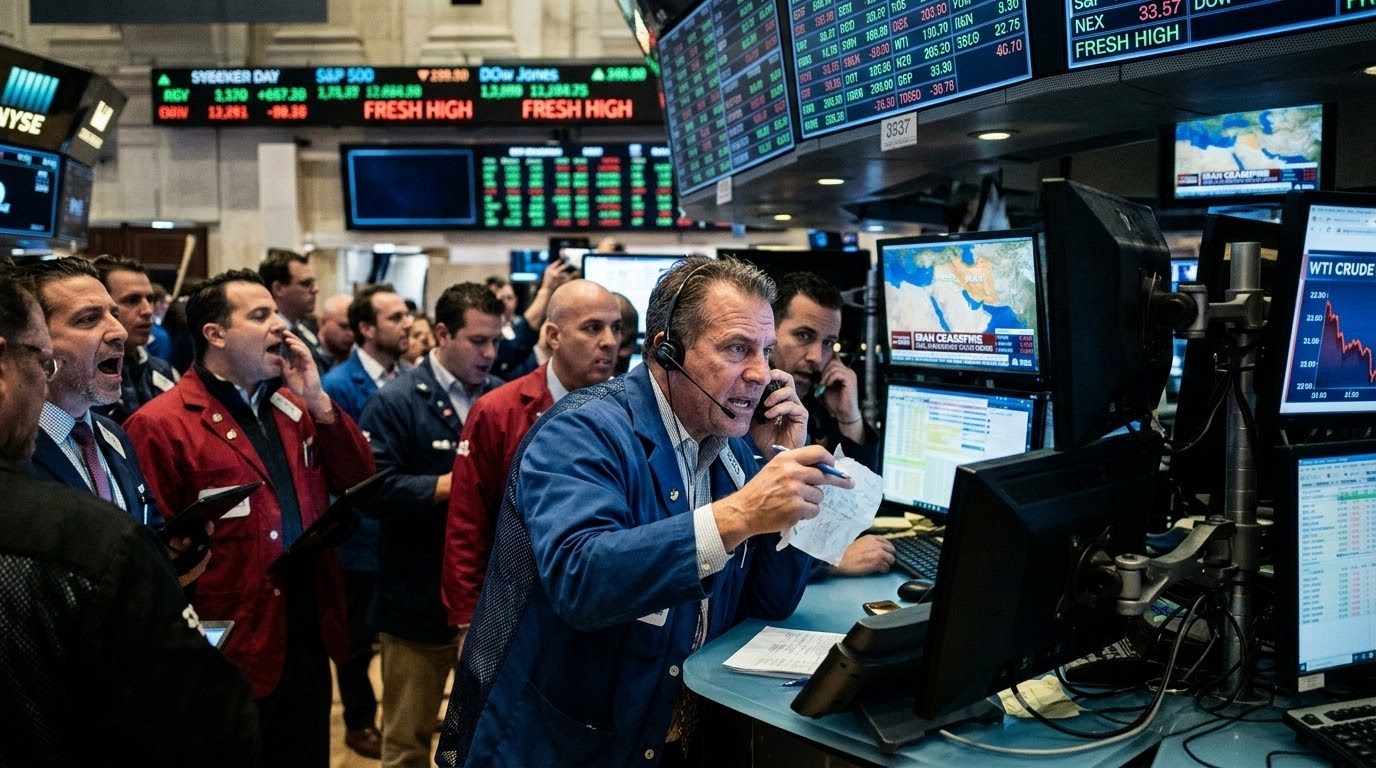
US financial markets climbed near historic peaks on Wednesday while oil prices fell steeply, as investors reacted to reports that Washington and Tehran may be moving closer to a ceasefire arrangement. The shift mattered globally because any easing of tensions around the Strait of Hormuz could reduce immediate threats to energy flows and calm broader economic anxiety.
What Happened
Trading momentum strengthened during the session as negotiations between the United States and Iran continued, with investors increasingly betting that a diplomatic breakthrough could restore safer shipping conditions through one of the world’s most strategically important energy corridors. Iran’s state broadcaster said it had obtained a preliminary text setting out a possible framework, triggering an immediate repricing in crude markets.
US benchmark crude dropped 5.5 percent to settle at $88.68 per barrel, while Brent slid to about $92, a sharp retreat after both contracts had traded above $100 the previous week. According to the reported framework, maritime traffic through the Strait of Hormuz would return to pre-war levels within 30 days, and the United States would remove its naval blockade of Iranian ports.
The White House later rejected the broadcast account, describing it as a “complete fabrication,” but the denial did not fully reverse market sentiment. Equities held gains: the S&P 500 rose 0.1 percent, extending a record set the previous day; the Dow Jones Industrial Average was up 243 points, or 0.5 percent, late in the session; and the Nasdaq Composite was also 0.1 percent higher.
Impact & Consequences
The immediate consequence was a powerful signal from markets that energy risk premiums can unwind quickly when diplomatic progress appears plausible, even when official narratives conflict. Lower crude prices, if sustained, could ease pressure on fuel costs, inflation expectations, and industrial input prices across major economies. For central banks, a durable decline in oil would reduce one of the most volatile components in consumer price trends.
At the same time, the move exposed how fragile current confidence remains. Traders have repeatedly rallied on reports of de-escalation only to retreat when talks stall. A failed negotiation cycle could rapidly push oil higher again, tighten financial conditions, and reignite concerns over supply shocks. For governments and corporations dependent on stable shipping lanes, the latest price action underscores both the benefits of a diplomatic settlement and the cost of prolonged uncertainty.
Background & Context
Wednesday’s rally followed a familiar pattern from earlier phases of the conflict, when optimism over possible agreements temporarily lifted risk assets and lowered energy prices before reversals set in. What distinguished this episode was the combination of renewed public messaging from senior US officials and a reported draft framework that offered concrete, time-linked operational steps on maritime access.
Still, core disputes appear unresolved. Major outstanding issues include the future of roughly 440 kilograms of highly enriched uranium, the extent of dismantling expected for Iran’s nuclear infrastructure, Tehran’s ballistic missile capabilities, and its backing of armed groups in the region. Questions also remain over whether any US-Iran accord would incorporate a halt to hostilities in Lebanon, a condition Iranian officials have repeatedly raised, even as Israeli Prime Minister Benjamin Netanyahu has ordered intensified operations against Hezbollah.
International Response
Public comments from Washington suggested guarded confidence rather than a finalized agreement. During a cabinet meeting, President Donald Trump said US officials were not yet satisfied but added that they would be, signaling that negotiations were still active but incomplete. His remarks indicated pressure tactics remained central to the US approach.
Regional and international stakeholders are closely monitoring whether talks can bridge security, nuclear, and sanctions disputes simultaneously. Any arrangement involving maritime access, military de-escalation, and sanctions relief would require coordination across multiple governments and security institutions. Market participants, meanwhile, treated even partial progress as meaningful, suggesting global actors view a Hormuz de-risking scenario as a critical stabilizer for trade and energy systems.
What to Expect Next
Attention will now focus on whether negotiators can convert broad signals into verifiable commitments on shipping, nuclear controls, and sanctions. Investors are likely to react quickly to any confirmed text, official joint statement, or visible military pullback around key routes. If talks falter, oil could rebound sharply and equities may surrender recent gains; if a credible framework emerges, markets may continue pricing in a lower-risk energy outlook.