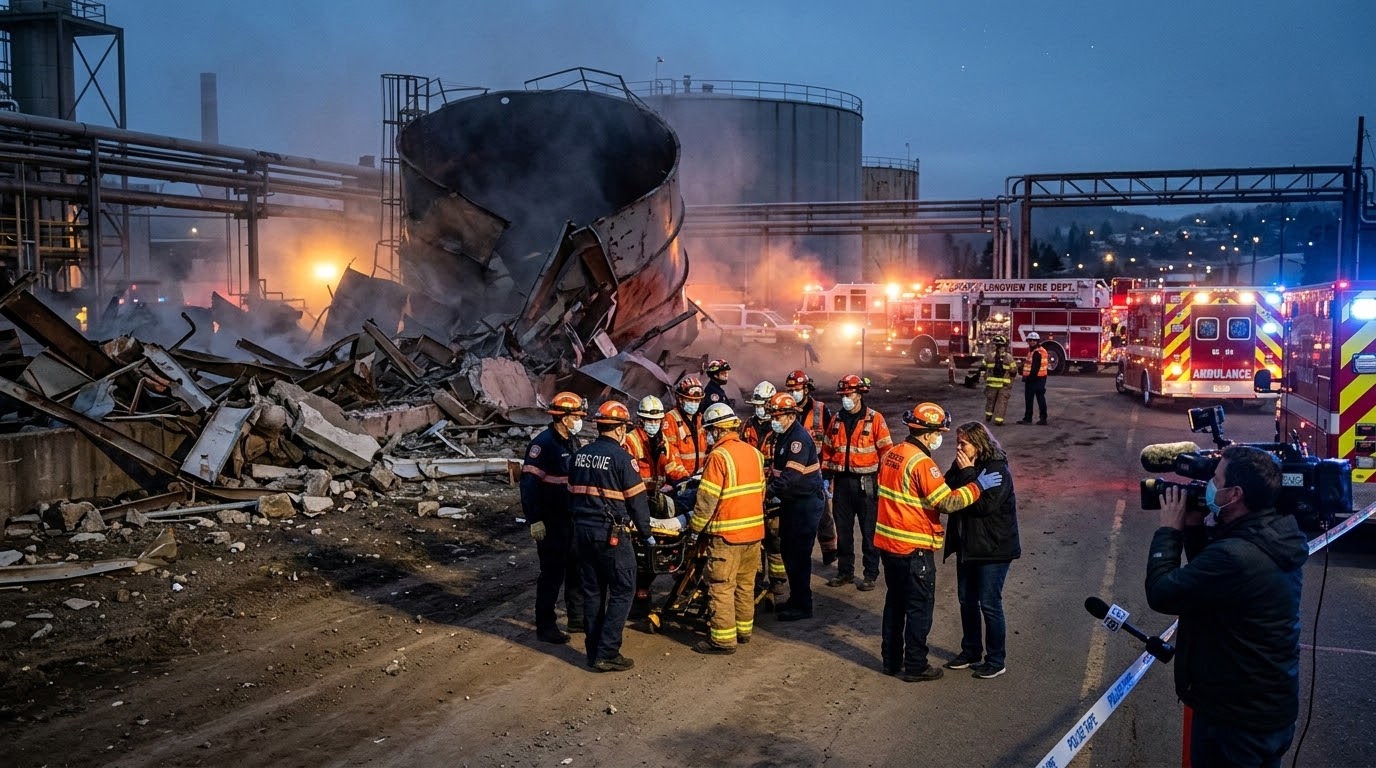
Several people were killed and others critically injured after a large chemical tank imploded Tuesday morning at Nippon Dynawave Packaging in Longview, Washington, authorities said, in an industrial accident that has renewed concern over worker safety at high-risk processing sites in the US Pacific Northwest.
What Happened
The incident occurred at about 7:15am local time at the company’s facility in Longview, a city in Cowlitz County roughly 70 kilometers north of Portland, Oregon. In a joint statement, the Longview Fire Department, the Cowlitz County Sheriff’s Department, and Nippon Dynawave confirmed deaths linked to the event and said multiple people suffered life-threatening injuries. Officials did not immediately release a final casualty count.
Emergency crews remained on site through Tuesday as responders treated patients with chemical burns and other trauma before transferring them to regional hospitals. Scott Goldstein, chief of Cowlitz 2 Fire and Rescue, told reporters that at least nine workers and one firefighter were transported for medical care. He said the number of fatalities was still undetermined while response operations and notifications continued.
Authorities identified the failed vessel as an 80,000-gallon tank that was about 60 percent full at the time of rupture. The tank contained white liquor, a caustic pulp-processing solution made from sodium hydroxide and sodium sulfide. Officials emphasized that, despite the severity of the plant emergency, there was no immediate hazard to nearby neighborhoods. PeaceHealth St John Medical Center in Longview said it received nine patients connected to the incident, including one person who died; six were listed in fair condition, and two were transferred to other facilities, according to information provided to ABC News.
Impact & Consequences
The accident has immediate human and operational consequences for Longview and the surrounding industrial corridor. Families are awaiting formal casualty confirmations, while injured workers face treatment for burns and possible long-term complications associated with chemical exposure. The hospitalization of a firefighter also highlights the risks first responders confront in confined industrial environments where toxic substances and structural failures can overlap.
For the facility and its parent operations, the incident is likely to trigger a prolonged disruption. Industrial fatalities in a chemical-processing context commonly lead to multiple inquiries involving local agencies and workplace regulators, along with reviews of equipment integrity, maintenance records, and emergency protocols. Even before formal findings are released, the event may influence insurance costs, safety audits, and production timelines at pulp and packaging plants that rely on similar high-volume chemical storage systems.
Background & Context
White liquor is a core input in paper pulp manufacturing and is widely used in kraft pulping processes. Although essential to production, the solution is highly corrosive, requiring strict controls over tank condition, pressure management, and handling procedures. Failures involving large-volume chemical vessels can rapidly escalate because they combine mechanical force with hazardous exposure risks.
The Longview emergency unfolded as another industrial tank incident was being monitored in California. In Garden Grove, authorities had been tracking an overheating tank containing methyl methacrylate, a flammable chemical used in plastics manufacturing, at a GKN Aerospace site. Officials said the worst-case explosion scenario there was ruled out Monday after a crack released pressure. By Tuesday morning, Orange County Fire Authority spokesperson Greg Barta said temperatures had stabilized and crews were working to allow evacuees to return home. Together, the two incidents have sharpened attention on storage infrastructure and emergency planning across different sectors handling dangerous chemicals.
International Response
No foreign government response had been publicly announced as of Tuesday, but the incident has drawn broader attention because Nippon Dynawave operates under Japanese corporate ownership while maintaining major US industrial operations. Cross-border companies in hazardous manufacturing are often expected to coordinate transparent communication with local authorities, workers’ families, and regulators after fatal events.
Safety specialists and industry observers are likely to follow the Longview investigation closely, particularly given the near-simultaneous concern over tank stability in Southern California. While the two events involve different chemicals and circumstances, they add to wider debate among emergency management and industrial-risk professionals about aging infrastructure, preventive maintenance standards, and the speed of hazard detection in facilities handling large chemical inventories.
What to Expect Next
Officials are expected to release updated casualty figures once identifications and family notifications are complete. Investigators will focus on what caused the white liquor tank to fail, whether safeguards functioned as designed, and if any compliance violations occurred. Additional medical updates on hospitalized workers and the injured firefighter are anticipated, along with decisions on plant operations, cleanup timelines, and any enforcement or legal actions that may follow.